
Cost overruns are common in commercial construction projects. Many projects end up costing more than anticipated. For real estate investors, developers, architects, and builders, the real challenge is not whether budget overruns happen. But the actual problem is how to tackle these issues. This guide will help you understand the underlying issues that cause cost overruns. Moreover, it will provide a few tips and tricks to reduce construction cost overruns for your projects in 2026.
IF YOU ARE ON A COMMERCIAL PROJECT AND YOU WANT TO GET A FREE ESTIMATE FROM AN EXTERNAL COST CONSULTANT BEFORE COMMITTING TO THE BUDGET, FEEL FREE TO DO SO! GET A PROFESSIONAL QUOTE BEFORE ENTERING THE BIDDING PROCESS!
The 5 Root Causes That Drive Budget Overruns

Understanding the cause is the first step to preventing cost overruns. Cost overruns are not a new problem, and they are not random. MDPI – Key Factors of Cost Overrun Based on Structural Equation Modeling consistently detects the same clusters of root causes, such as:
- Poor project management
- Resource misallocation
- Supply chain failures
- Weak contract administration
Although external factors such as weather or inflation play a significant role. But internal management failures are almost always the dominant driver of cost overruns.
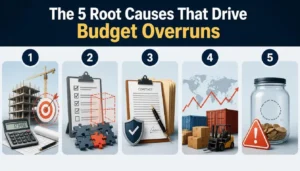
In many projects, cost overruns occur due to the following five common reasons:
-
Inaccurate early-stage estimating
Budgets built on incomplete drawings, rough assumptions, or outdated unit costs create a false baseline. As the project scope becomes clearer later, real costs usually rise. But at that time, the project had already moved forward. This makes it difficult to avoid these costs.
-
Poor scope definition and scope creep
One of the best indicators of overruns is changes in scope mid-project. Every change is an additional cost item, creates delays, and disrupts other trades.
-
Weak contract and procurement management
Management insufficiencies lead to increased resource problems, while expert internal management removes external issues.
-
Supply chain volatility
Material price increases and lead time delays have become much less predictable since 2020. Estimates that do not consider price rises or alternative material options lead to budget overruns.
-
Insufficient contingency allocation
A too small or too large contingency does not protect a budget. It simply delays the point at which a project goes over budget.
What Proper Contingency Actually Looks Like

Construction contingency is not just additional money added to the budget. But it is a planned reserve for potential risks depending on the specific needs of a project. It is imperative to understand two main types of contingencies to use them effectively.
-
Design contingency
It covers uncertainty during the design and preconstruction phase, when scope is still evolving. This is usually higher at early design stages, about 15–25% of construction cost. But later on it decreases as the design becomes more detailed.
-
Contingency Fund
It includes sudden situations in the build phase, e.g., unplanned site circumstances, slight scope changes, and coordination issues. This is usually 5-10% of construction expense, depending on the level of complexity.
The most common problem that project owners often make is using one fixed contingency amount for the entire project. It may be too large an amount to justify or too small an amount to cover risks. In many projects, it is not accurately traced as contingency funds are used during construction.
How Cost Estimating Services Reduce Overrun Risk

One of the most effective ways to eliminate construction cost overruns is to have independently reviewed estimates. When contractors prepare without separate verification, it might lead to an underestimated project budget.
Professional construction cost estimating services offer an independent baseline that:
- Uses current, regional unit costs rather than outdated averages.
- Identifies differences between drawings and specifications.
- Produces a defendable, line-item budget that can be settled against contractor bids.
The Role of BIM and Digital Tools in Cost Control

Building Information Modeling is one of the most effective technology-side tools for reducing cost overruns. BIM considerably reduces the risk of choosing the lowest bidder by improving coordination and accuracy.
The practical advantage is clash detection before construction starts. It detects clashes between structural, mechanical, and electrical systems inside the model, where they are easier and cheaper to fix. Projects that use BIM from design stage to construction documentation will face:
- Fewer RFIs
- Fewer change orders
- Better cost control
Pre-Construction Checklist: 7 Steps To Reduce Construction Cost Overruns
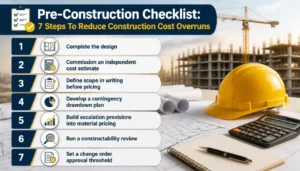
The key to avoiding budget overruns is to do so before construction begins. Check the following as a checklist of the seven steps that can keep projects on track:
Complete the design
Complete the design to at least 60–70% before finalizing the budget. Estimates made on schematic drawings are often less accurate compared to those prepared from detailed construction documents.
Commission an independent cost estimate
Separate cost estimates from the contractor’s bid, verified against current market data
Define scope in writing before pricing
Define scope before pricing every item. Anything that is not included in the contract scope leads to a change order.
Develop a contingency drawdown plan
Outline the process for and by whom contingencies can be approved and keep a record of them as they occur.
Build escalation provisions into material pricing
Do this especially for steel, concrete, and MEP equipment with long lead times.
Run a constructability review
Have an experienced construction manager review drawings for coordination gaps before bidding
Set a change order approval threshold
Slow change order review is one of the most common sources of schedule delay and associated cost escalation.
NEED HELP BUILDING A PRE-CONSTRUCTION COST STRUCTURE FOR YOUR NEXT PROJECT? GET EXPERT ESTIMATION TO COVER EVERYTHING FROM SCHEMATIC BUDGETS TO BID RECONCILIATION AND CHANGE ORDER REVIEW.
Conclusion
Construction cost overruns are a systemic problem. But they are not unavoidable. Most budget overruns are due to poor management in planning, estimating, and resource coordination. These overruns are not due to random external forces. The projects that follow accurate estimating, proper contingency allowances, and clear cost planning stay on track. There are several methods available to reduce construction cost overruns in 2026. The key is to use them early in the process.
Frequently Asked Questions
Q1: What percentage of construction projects experience cost overruns?
The majority of commercial construction projects finish over their original budget. About 70–90% of projects go over budget based on project type and complexity.
Q2: What is a reasonable contingency fund percentage?
It depends on the project phase and complexity. Initial design contingencies range from 15–25% of estimated cost, reducing to 5–10% as design improves.
Q3: How does poor contract management lead to cost overruns?
Unclear contract scope, undefined risk allocation, and weak change order controls all create conditions where additional costs accumulate. Contract management failure is one of the top drivers of cost overruns.
Q4: What is the difference between a cost overrun and a change order?
A change order is a formal amendment in the contract scope and price. A cost overrun is the difference between the original budget and the final cost.