If you are laying a patio or building a garage floor, then you need to calculate the concrete volume for a slab accurately. There is no choice other than accuracy in calculation. You know exactly how much concrete you need. You can move on and complete the process without any mistakes. For that, you need to understand the most important steps. But if you underestimate, then it will lead to expensive delays and waste money and materials.
But do not worry, it is a straightforward process that you can understand. But as a building owner, it is difficult to estimate different things because of prices, fluctuations of materials, and other risk factors. If you rely on professional concrete estimating services, then you are in safe hands. From taking measurements to placing your final order, the expert estimators provide pinpoint estimates. Let us show you why accurate concrete volume calculation matters.
READ OUR GUIDE TO UNDERSTANDING HOW TO CALCULATE CONCRETE VOLUME FOR A SLAB IN DETAILED STEPS!
Why Accurate Concrete Volume Calculation Matters
It is a must to get your concrete volume accurate. It is not just for saving money; it affects the overall quality and timeline. To properly understand it, go through these points:
- Concrete is sold by the cubic yard or cubic meter. Ordering the right amount avoids unnecessary expenditure.
- Too little concrete means rushed pours and weak joints
- Too much creates waste and potential disposal problems.
- Running short mid-pour can compromise the structural integrity of the slab
- Accurate calculations keep your schedule on track.
What You Will Need Before You Start
Before beginning the calculation, you need the following tools and information. Make sure not to neglect any of these components.
- Measuring tape
- laser distance measurer
- A notepad
- smartphone for recording measurements
- A calculator (or an online concrete calculator)
- Your construction or project plan showing slab dimensions
- Knowledge of the required slab thickness for your application
Understanding Standard Slab Thickness
The thickness of the concrete depends on its use.
For residential projects, 4 inches is very common for shoes and walkways.
For garage floors, a 5-6 inch thickness is required.
Whereas, for commercial use, 6 to 8 inches or more is required.
That means choosing the right thickness is also important before you start calculating the volume. If you choose the wrong one, then it will throw off your estimate.
The main formula
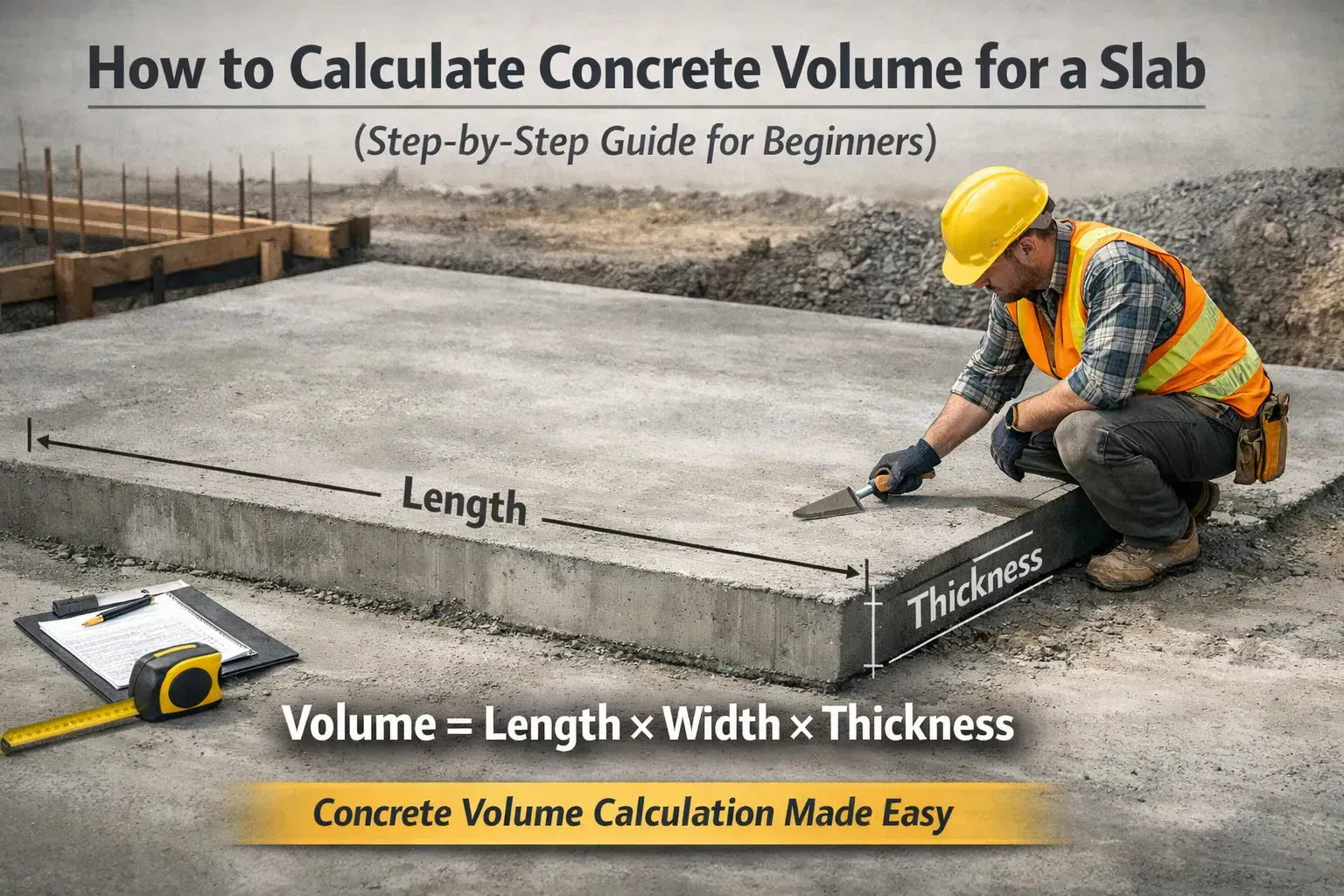
The volume formula for a rectangular prism in cubic feet is:
= Height (ft) × Width (ft) × Length (ft)
Concrete is ordered by the cubic yard.
For that, divide the result by 27.
In metric units:
Volume (m³) = Length (m) × Width (m) × Thickness (m)
Steps to calculate the process
Step 1: Measure the Length and Width
Use a tape to record the full dimensions.
- Measure the longest side first
- Then measure the perpendicular side
- Record both in the same unit
- For irregular shapes, convert them into smaller rectangles
Step 2: Slab Thickness
You need to keep in mind that the thickness is always measured vertically!
- Convert inches to feet by dividing by 12
- Convert millimeters to meters by dividing by 1,000 for metrics
- Add ¼ inch to the thickness of your slab for your concrete budget
Step 3: Volume Formula
Multiply your three measurements together:
Volume = Length × Width × Thickness
Understand it by this example:
- Length is 15 ft
- Width is 10 ft
- Thickness is 4 inches. This means it is 0.333 ft
- Use the formula and 15 × 10 × 0.333
- The result is 50 cubic feet
Step 4: Converting into Cubic Yards
The next thing is to divide the result by 27. It will convert into cubic yards.
Step 5: Add a Waste
Never ever ordered the exact calculated amount!
During the mixing and pouring process, there is a waste of materials. So, it is a good idea to consider 5 to 6% more concrete than estimated.
If you are not capable of calculating it then it is better to get help from expert concrete estimators because they are aware of the right methods and market conditions.
Handling Irregular and Sloped Slabs
It is not necessary that all the slabs are in a rectangular shape. They can be in irregular shapes.
For a regular shape, you need to break the area into simpler shapes. It can be in the form of a rectangle, circle, etc. You need to sum the totals together.
For a sloped slab,
Use average thickness =
(minimum thickness + maximum thickness) ÷ 2
For L-shaped slabs, divide them into two rectangles. You can calculate it separately and add them.
For Circular slabs,
Use this formula
= π × radius² × thickness
You need to avoid these mistakes
- Not converting units consistently
- Ignoring soil compaction
- Underestimating thickness
- Forgetting rebar displacement
- Skipping the overage buffer
- Measuring outside the formwork
Conclusion
We have discussed all the necessary steps to calculate concrete volume. Be careful with the measurements and using the formulas. By following the steps we have mentioned, you can confidently estimate. This will help you avoid expensive mistakes. Plus, this makes sure that the project will move on without hurdles. However, it is highly recommended to get expert help to avoid mistakes.