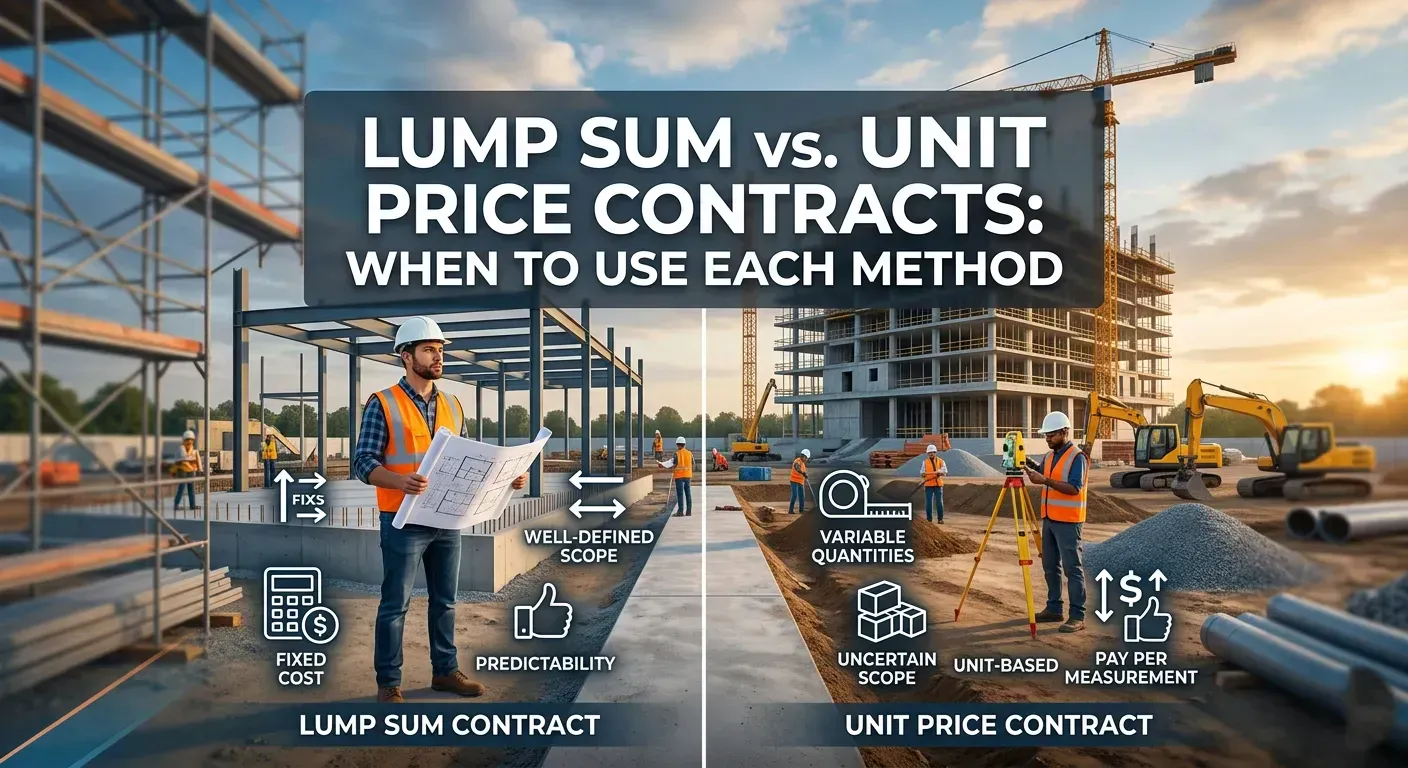
This guide is best for contractors and building owners to compare lump sum vs unit price contracts.
Choosing the right contract is one of the most important decisions. The type you select determines how:
- Risk is shared
- changes are handled
- payments are processed
However, two of the most common pricing formats are the lump sum contract and the unit price contract. The important thing is to understand when to use each. Because it makes a difference between a smooth building process and costly mistakes.
If you are going to start your building project, then you must invest a proper time in understanding how to deal with suppliers and other members. If you have no experience in this shield then get professional construction estimating services from my reliable company. They are aware of all the risk factors. Working with them means you are safe with your finances and completing the project on time.
What Is a Lump Sum Contract?
A lump sum contract is also a fixed price contract.
It is used when the scope of the work and schedule are clearly defined and agreed upon by both parties.
The contractor completed the entire project for a single pre-negotiated price. There is no price for a single item. You agree on a number and the contractor delivers the finished work to you.
Under this contract, the contractor assumed most of the quantity and cost risks
If the contractor’s actual costs exceed their estimates, the contractor absorbs the loss.
Let us show you the most prominent points of this contract:
- A single, fixed price covers the entire project
- The contractor bears the financial risk of cost overruns
- Any additions or removals in scope are handled through formal change orders
- Budget predictability is maximized for the project owner
- Requires comprehensive and accurate documentation before work begins
What Is a Unit Price Contract?
Unit price contracts in construction are calculated based on the cost of each separate unit of work. There is no fixed fee for the entire project.
In these contracts, the payments are based on the measured quantities of the completed work.
However, the simple concept is that a unit price bid is when the project is broken into a single price per unit. After that, the quantities of these items are multiplied by their unit price. Then they are summed up. The points to be noted for this type of contract are:
- Payment is tied to actual quantities of work completed
- The total project cost is not known at the outset
- Risk is more evenly shared between the contractor and the owner
- Ideal for projects where the full scope cannot be determined upfront
- Invoices include a transparent breakdown of units executed and their corresponding cost
When to Use a Lump Sum Contract
Lump sum contracts are beneficial for projects that have complete information. They allow the contractor to plan and control the budget more accurately.
Best situations for lump sum contracts:
- Building a residential or commercial structure from finalized architectural drawings
- Renovation projects where existing conditions are thoroughly documented
- Short-duration projects with minimal risk of scope change
- Government or public sector projects requiring a firm budget commitment
But you need to watch for:
- Lump sum contracts require more accurate and detailed estimates. This increases the risk of errors.
- Change orders can become expensive and contentious if scope creep occurs
- Contractors may inflate their bid to cover worst-case scenarios
When to Use a Unit Price Contract
Unit price contracts are beneficial when the quantities are not known. These contracts are often suitable for repeatable work. This means that the exact amount of work required is not known.
Plus, a unit price contract defines a set cost for a unit of work.
It is a repeatable pattern of materials and labour.
If you are constructing a 1-mile stretch of highway. It involves the same equipment and materials. This means that the contractor can determine the per-unit cost for the overall work.
Best situations for unit price contracts are:
- Road construction, utility installation, etc.
- Projects that can begin before final designs are fully complete
- Long-term maintenance or service agreements with fluctuating workloads
- Projects where the owner wants transparency into component costs
Potential drawbacks:
- The total cost of the project is unknown. Some delay in payments can also happen.
- Owners carry more financial exposure if quantities exceed estimates
- Requires rigorous quantity tracking and documentation throughout the project
Making the Right Choice
The right choice depends on the project complexity. Plus, the most important thing is how well the scope is.
The risk tolerance of both parties also matters. Compare the choices with the help of this table.
| Factor | Use Lump Sum | Use Unit Price |
| Scope definition | Fully defined | Partially unknown |
| Risk preference (owner) | Transfer risk to the contractor | Share risk with the contractor |
| Project type | Building, renovation | Roads, utilities, earthwork |
| Design readiness | Complete drawings available | Design may still be in progress |
| Budget certainty | High priority | Secondary priority |
| Quantity predictability | Stable quantities | Variable or uncertain |
Conclusion
By comparing Lump sum vs unit price contracts, you can smoothly complete the project. By choosing the right contract for the right situation, everything can be handled carefully. From estimating to the project management process, the best thing is to make sure that the contract is completed with enough information to prevent mistakes!