If you are going to upgrade an electrical panel, then you need to be overly precise to calculate the electrical load. Why? Because accuracy in calculation will help you protect your investment. The process of this calculation is quite critical. You need to understand that an undersized service can cause tripped breakers and other major issues. However, the right numbers will help you pass the inspections.
Most residential contractors and investors do not rely on their judgment for electrical work. They get professional Electrical Estimating Services from a reliable company. Expert estimators are trained because they have gone through several projects and completed them on time and on budget. That is why we have prepared this guide for you so that you can use the latest standards and calculate the electrical load for residential buildings.
GET ALL THE STEPS IN DETAIL ABOUT HOW TO CALCULATE ELECTRICAL LOAD FOR RESIDENTIAL BUILDINGS!
Why Electrical Load Calculations Matter
To calculate the electrical load for Residential Buildings in this advanced world. Accurate residential load calculations are more critical than ever!
The increase in high-demand technologies like electric vehicles, tankless water heaters, etc. It has placed stress on residential electrical systems.
Thus, accurate calculation will lead to undersized service equipment. This creates fire hazards and an inability to use appliances as required.
This is the main reason that 200-ampere service is becoming the standard for new residential construction.
It provides the necessary capacity to safely use the modern heat pump alongside a dedicated EV charger and other electrical amenities.
The Two NEC Methods at a Glance
The NEC provides two different parts for calculating a home electrical load.
The Standard Method is the most detailed approach. It requires specific loads from general lighting to fixed appliances. It is versatile and can be used for any type of unit.
The second one is the Optional Method, which is a faster and more defensible calculated demand for single dwellings.
It is best for single dwellings on 120/240 V with service of 100A or greater.
Several homeowners choose the optional method.
However, Professional Cost Estimating Services are developed on the basis of an accurate selection of methods and the project’s needs. It is better to get help from the experts rather than getting stuck in the middle of the project!
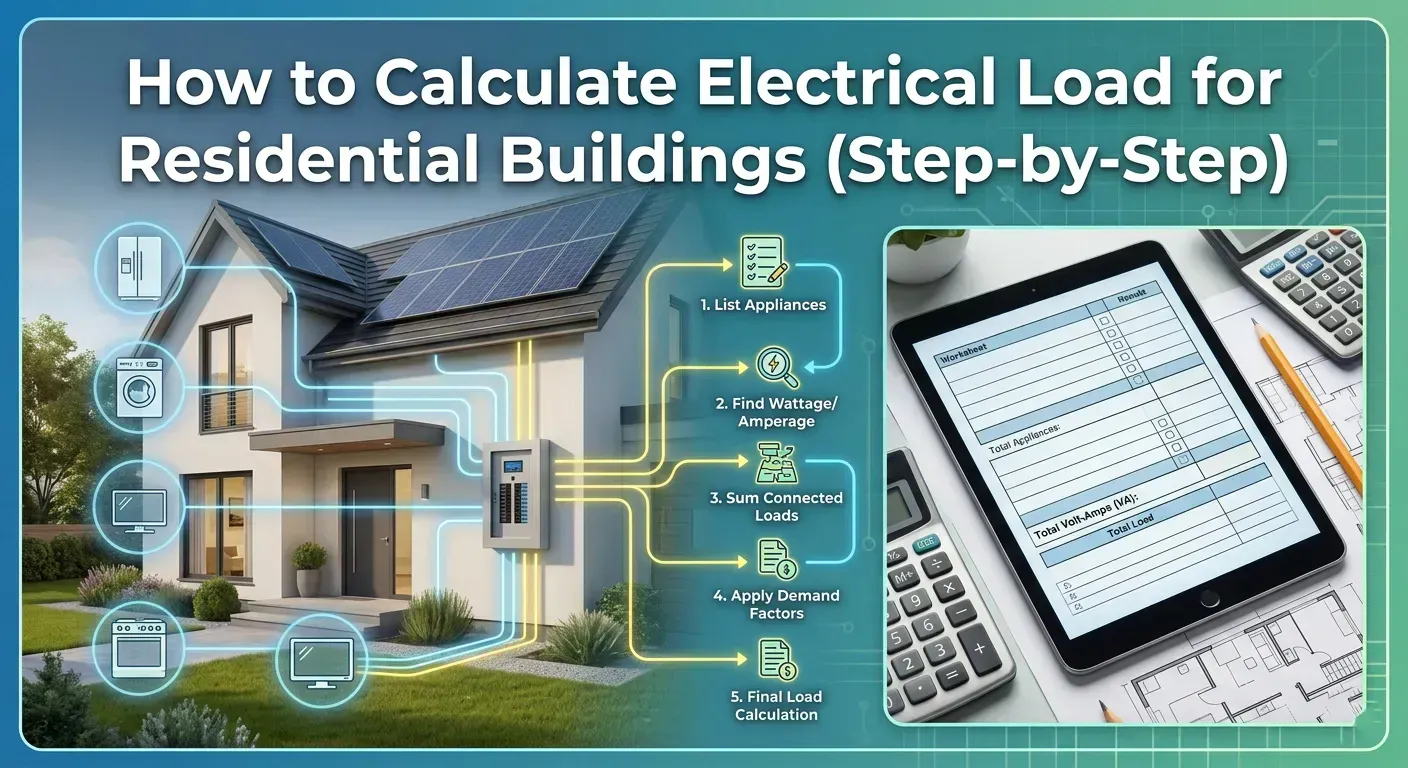
Steps of Standard Method Load Calculation
Step 1 — Determine the Square Footage
For calculating general lighting loads, all the square footage counts are not necessary. So,
- Measure the total floor area in square feet
- Exclude these:
- garages
- open porches
- unfinished basements
- Include all bedrooms and finished areas
Step 2 — Calculate General Lighting
Apply this formula:
General Lighting Load
= Total Square Footage × 3 VA/sq.ft.
According to NEC 220.41, you must use no less than 3 VA per square foot.
Step 3 — Add Small Appliance
The next step is to add the required small appliance and laundry branch circuits. These steps include:
- Minimum of two small-appliance circuits = 2 × 1,500 VA = 3,000 VA
- One laundry circuit = 1,500 VA
- Additional circuits added at 1,500 VA each
- These circuits cannot serve lighting or other outlets
Step 4 — Apply Demand Factors
Combine the values from Steps 2 and 3. This will help you get the total lighting load.
After that, you need to apply the demand factors.
Step 5 — Calculate Major Appliance Loads
In this step, individual appliances are added with their specific demand factors.
Step 6 — Total the Load and Determine Service Size
Add all adjusted loads together to get the Total Demand VA.
To determine the required service amperage:
Divide the Total Demand VA by 240
After that, select the next standard OCPD size.
Formula:
Service Amps = Total Demand VA ÷ 240 V
These steps may seem difficult to you as an inexperienced estimator or a residential building owner. That is why most owners outsource residential electrical takeoff services to save budget and timeline.
Quick Summary of the Steps
- Measure habitable square footage and exclude garages, porches, etc.
- Apply 3 VA/sq.ft. for general lighting
- Add 3,000 VA for two mandatory small-appliance circuits
- Add 1,500 VA for the laundry branch circuit
- Apply demand factors
- Add an electric range
- Add heating at 100%
- Use only the larger of heating or cooling
- Add dryer at 5,000 VA minimum
- Apply 75% factor
- Multiply continuous loads by 125%
- Add EV charger load
- Divide the total VA by 240
- Round up to the next standard breaker size
- Minimum 100A service
Conclusion
In short, for a medium house, a 200-amp power box is usually enough. It is best if you use a smart tool to limit the power of the car. However, if you have a faster charger, then the math gets close to 200 amps or more. To calculate the electrical load for residential buildings, you need to look closely at all the rules to see if your current power box can stay. Always check your local building rules. They change from time to time, so never ignore them. If you are not sure, then get expert assistance. This is very important for new homes!