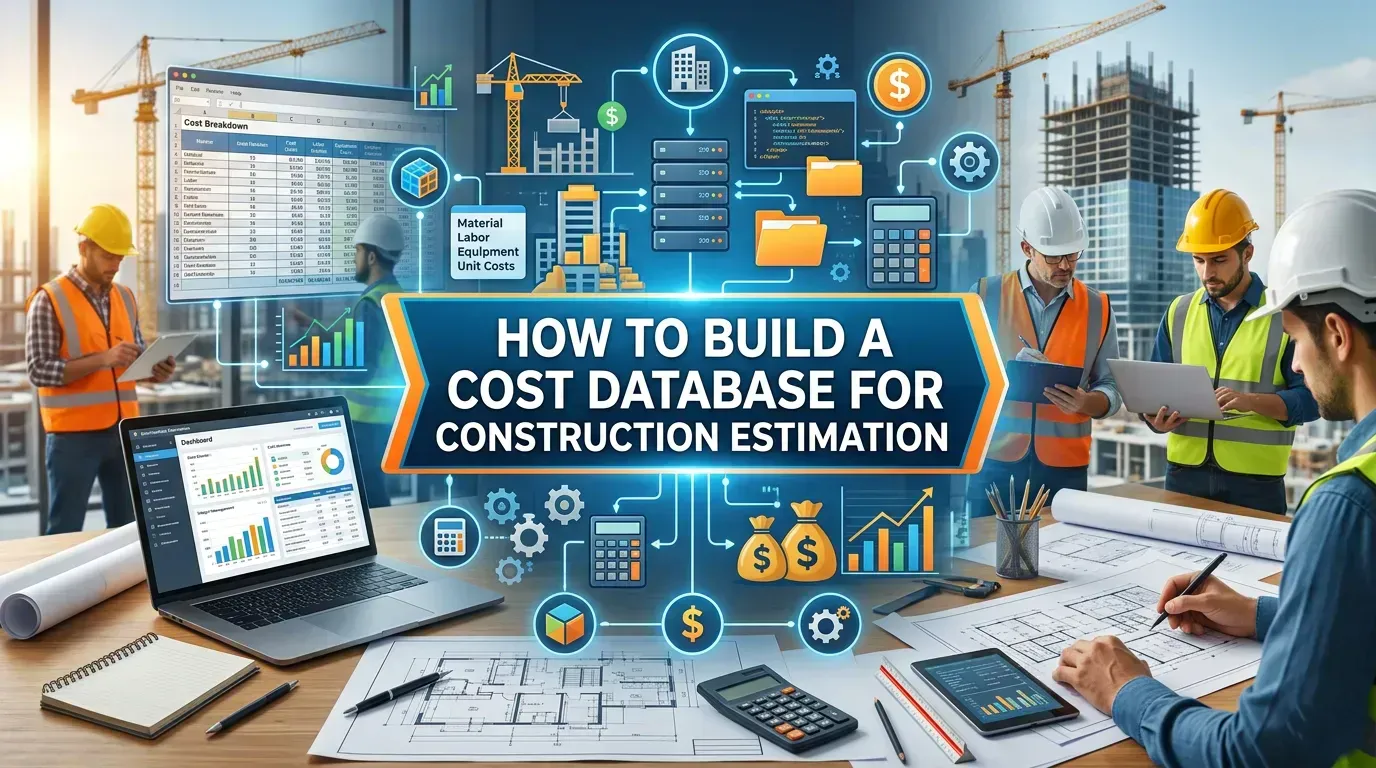
The construction industry is demanding accurate cost estimation for every project type due to current challenges. “Accuracy” is the single most important factor in the whole estimation process that decides whether you will succeed at the end or not. It let the contractors win the bid and walk away from the losses. Unfortunately, various firms still choose the manual method and outdated vendor quotes. As a result, the project faces over-budgeting and delays.
The solution to this problem is to get access to a live cost database. It is an organized repository. It helps you to know what construction actually costs.
Moreover, a construction cost database consists of cost information related to materials, labor, etc. It guarantees up-to-date and reliable costs that help to develop expert construction estimating services to win bids. Contractors and clients can make perfect decisions and stay within budget. So, is it better to rely on outdated methods or advanced ways of predicting project expenses?
ESTIMATORS AND CONTRACTORS MUST READ THIS GUIDE TO UNDERSTAND HOW TO BUILD A COST DATABASE FOR CONSTRUCTION ESTIMATION!
Why a Cost Database Is No Longer Optional
The construction industry creates a huge amount of data. Most forms are nothing without the data. If you are still relying on manual methods of data collection, then it is a costly habit.
When the project expenses are scattered across silos. The teams generate inaccurate estimates. Plus, they are time-consuming and result in budget overruns that eliminate profit margin.
It is better to switch to a data-driven preconstruction process. It will save your time and make your project workflows quicker and more accurate.
In short, a cost database is a competitive advantage. So, compete with your rivals with utmost accuracy!
Steps to build a cost database for construction estimation
Step 1: Gather Data from Multiple Sources
A database can never be built without data.
The first step is gathering reliable data with great effort. You must have the project completed records. It includes:
- Final cost reports
- subcontractor invoices
- change order logs from your own past projects
After that, you must have supplier and vendor courts that consist of the current pricing of everything.
Famous databases like RSMeans Data contain:
- over 85,000 unit prices
- 25,000 building assemblies
- 42,000 facilities repair
- remodeling costs covering every category of construction
The labour rates must be according to the recent market conditions. Moreover, you must also know the complete completion time of every task. This directly affects the labour cost accuracy.
Historical labor cost data are used to prepare construction cost estimates for building construction. It helps to predict the prices for the next projects according to the current market conditions.
Step 2: Establish a Clear Cost Structure
Raw data is useless without organization.
It is important to decide how your database will be organized before you start loading information into it:
- Use an industry-standard coding system
- Organizing costs by CSI MasterFormat divisions to navigate.
- Separate unit costs from assemblies
- Unit costs cover individual line items
- Build square-foot cost models by building type
- General contractors should develop and maintain square-foot and unit cost databases
- Tag data by region and project type
Do not overcomplicate it!
It is one of the most common mistakes that makes the databases harder to maintain.
Step 3: Choose the Right Platform
Your platform also matters. It helps to choose how maintainable your database will be over time.
You can consider the following options:
- Modern estimating software like ProEst, CostOS, etc.
- Cloud-based platforms centralize data. It supports live collaboration across teams. Things are automatically updated for each other, which removes confusion.
- Larger firms sometimes build proprietary systems. It pulls data from ERP and project management platforms. This creates a true single source of truth.
By using features like templates, you can build projects based on historical cost. This means you do not have to start an estimate from scratch. However, this alone can cut your estimating time.
Step 4: Standardize Data Entry and Validation
A database is only reliable when it is organised well. Inconsistent data entry is the quickest way to make your database unreliable.
You need to write everything in a standard format for all the entries. It includes the unit of measure, labour rates, etc.
Assigned ownership so that one person is responsible for each data category. Also, make sure to recheck all the entries before they are added to the live database.
Plus, the best thing is to update the cost data weekly to keep the project estimate ahead of the market curve. The detailed cost breakdowns allow the teams to manage budgets according to the current conditions. Building estimates on the basis of such conditions prevents mistakes.
Step 5: Continuously Update and Improve
Continuously update your database because it never finishes. Due to market shifts and fluctuations in the labour rates, you need to continuously update your database.
Do not treat your database as a static document. It is a living system that should be improved more often
- Review and update material prices quarterly or after major market movements.
- Add actual cost data from every completed project within 30 days of project close-out.
- Benchmark your internal rates against commercial databases annually.
It helps you track and compare actual cost against the estimated cost. You can spot issues early and adjust them. Monitoring expenses helps the team to stay on budget and allocate the resources.
Conclusion
To build a cost database for construction estimation, you need to follow the right steps. Having the cost history at your fingertips allows you to build trust with your clients. The project delivered on time and on budget depends on this information. However, building a cost at waste requires investment in time and the right tools. So, never compromise on the accuracy of the estimates.