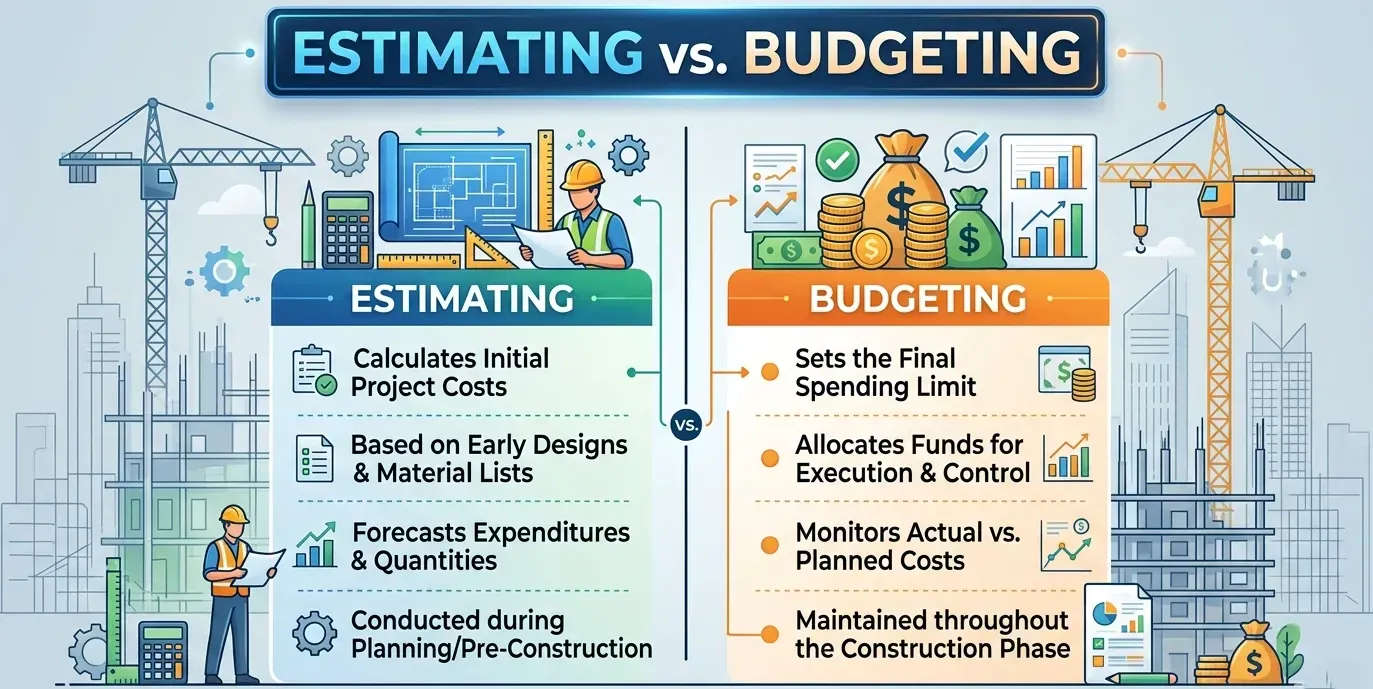
New contractors get confused between Estimating and Budgeting in Construction. In this challenging industry, some mistakes are quite expensive. For an untrained eye, they might seem like two words for the same thing. But for an expert contractor, conflating them is a fast track to eroded profit margins. The project goes over budget before the foundation is even poured.
However, the most common mistake contractors make is treating their initial estimate as the budget. Then they wonder why profitable projects lose money. Your estimate gets you the job. Your budget keeps you profitable. So, it is very important to clearly understand the differences between these tools. Use them accurately because they are one of the most critical financial skills in construction today.
READ OUR GUIDE TO UNDERSTAND ESTIMATING VS. BUDGETING IN CONSTRUCTION AND WHAT MOST CONTRACTORS GET WRONG!
The Core Difference
Let us provide the right meaning of both terms before diving into what most contractors get wrong.
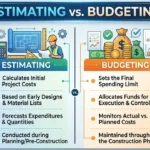
Construction Estimate
A Construction Estimate is an evaluation process of expected costs. It is used to win work and communicate cost ranges to clients. However, it is totally dependent on the phases.
- During schematic design, estimates are typically accurate to plus or minus 15 to 25 percent.
- By construction documents, estimates should be within plus or minus 5 to 10 percent of actual contractor estimates.
Construction Budget
A Construction Budget is a living financial document. It helps to track the actual cost against projected costs and adjust for changes. Professional Construction Estimating Services are developed according to the client’s budget. It helps to complete the projects under budget.
In short, the estimate is how you price the job. The budget is how you manage the money.
What Most Contractors Get Wrong
1. Using the Estimate as the Budget
This is one of the most common mistakes in the industry. The contractors face unpredictable cash flow with inaccurate estimates. They have to experience bidding errors that make future estimates essentially guesses.
Poor budgeting also directly impacts your ability to secure bonds and credit lines for larger projects. So,
- Never hand the field team an estimate and call it a budget
- Convert the estimate into a working budget with defined cost codes before work begins
- Treat the budget as a dynamic management tool, not a static number
2. Overlooking Soft Costs
All the attention is on the hard cost of the project. But soft costs are where the budget usually goes out of hand. Experienced Construction Cost Estimating Services never ignore considering soft costs.
However, various contractors neglect this cost without recognizing that they are just as important as hard expenses. So, miscalculating soft expenses even by a small margin can lead to financial issues.
Soft costs that contractors frequently miss:
- Permit fees
- Architectural fees
- Environmental studies and surveys
- Legal costs
- Furniture, fixtures, etc.
- Project management overhead
3. Relying on Industry Averages Instead of Historical Job Cost Data
Relying on industry averages or outdated estimating guides is dangerous. Your budgets must be built from the current market conditions. Your actual framing cost per square foot is far more accurate and reliable than any third-party average. This is one of the most overlooked disciplines in construction finance. Common mistakes in this area:
- Using RSMeans or similar guides without adjusting for local conditions
- Ignoring historical labor productivity rates from past projects
- Failing to track the variance between estimated and actual costs on completed jobs
- Not updating pricing databases after major material cost swings
4. Treating the Budget as Static, Not Dynamic
Many new contractors do not visit the site. This is one of the costly mistakes. You need to understand that construction projects are dynamic. It depends on the weather, design changes, etc. All these factors combine to impact the overall cost. The Best practices for dynamic budget management:
- Schedule weekly budget reviews against actual costs
- Flag variances immediately when they exceed a defined threshold (e.g., 5%)
- Update budget projections after every change order is approved
- Monitor cash flow weekly, not monthly
5. Ignoring Scope Clarity Before Budgeting Begins
Know the “what” and “how” before the “how much.”
This means that your plans must be clear to generate accurate estimates. However, design errors in the original project estimate frequently result in midstream project changes. This increases the overall cost as well as the delivery timeline. The signs of a poor scope are:
- Ambiguous drawings or incomplete specifications at bid time
- Undefined allowances for finishes or fixtures
- No written scope narrative to accompany drawings
- Undefined responsibilities for site prep, utilities, or temporary facilities
6. Mismanaging Change Orders
Change orders are like the blind spots in construction budgeting. If they are manually tracked or ignored, then the cost goes higher and higher! So,
- Always document and price changes before work begins
- Require written approval before proceeding with any scope changes
- Immediately update the master budget when a change order is approved
The Right Order from estimate to budget
If you are new to this field, then outsource Construction Takeoff Services to a reliable company. Otherwise, minor mistakes will eat your budget.
Let us provide you with the right order from estimating to budgeting:
| Stage | Tool | Purpose |
| Pre-Bid | Preliminary Estimate | Feasibility, go/no-go decision |
| Bid Submission | Detailed Estimate | Win the work, establish a contract price |
| Pre-Construction | Working Budget | Cost code setup, cash flow forecast |
| Construction | Live Budget | Real-time cost tracking, variance alerts |
| Post-Project | Job Cost Analysis | Feed future estimates with actual data |
Conclusion
Estimating vs. budgeting in Construction is important to understand for every AEC expert. It is the line between profitability and loss. Accurate budgeting allows contractors to plan with realistic contingencies and other needs. So, maximize profits with the right approach in this challenging industry.