
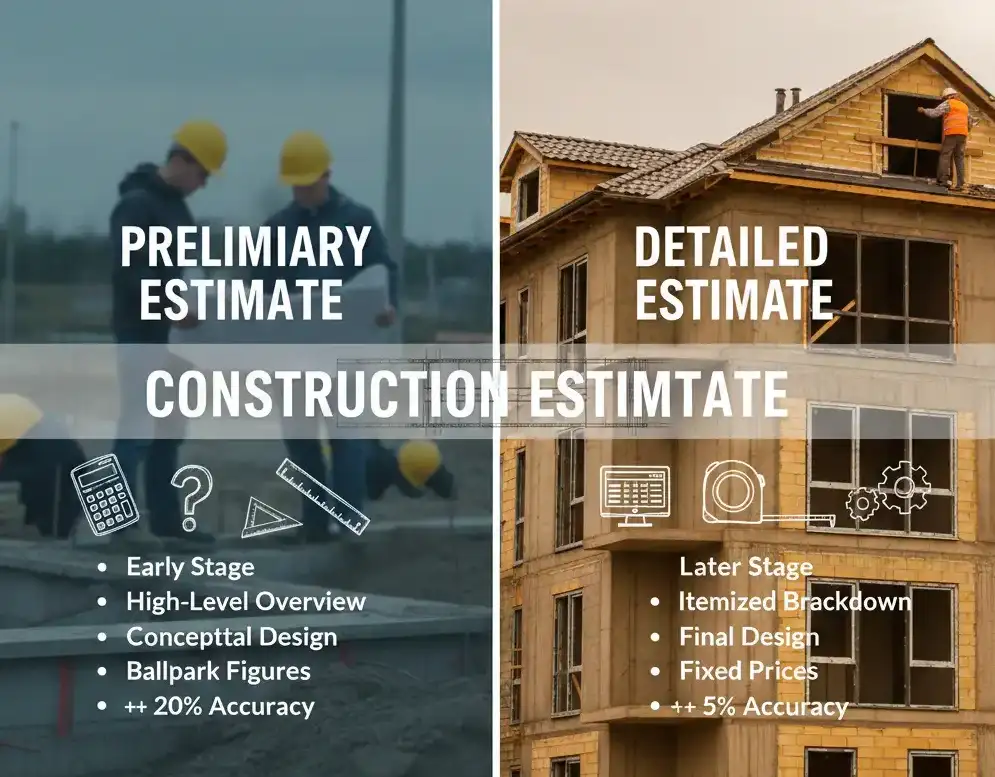
Preliminary estimates and detailed estimates are important for successful project planning and execution. It is very important to understand how much it will cost you. These types of estimates are used by contractors to make the perfect decisions. However, not all cost estimates are created equal. Various estimates offer their own purpose throughout the project time.
Well, these two estimation methods are used in different stages of the project. Plus, every type offers its own level of accuracy. Understanding the differences between them is important for the construction takeoff and estimation process. This way, you will not have to experience over-budgeting and construction delays.
READ OUR GUIDE TO UNDERSTAND THE DIFFERENCE BETWEEN PRELIMINARY AND DETAILED ESTIMATES IN CONSTRUCTION!
Preliminary Estimate Explained
The simple Preliminary estimate means that it is prepared during the very early stage of the construction project. You can say it is prepared in the conceptual phase. This type of estimate is developed with very little information about the project.
In this stage, detailed drawings and plants are not completed yet. The purpose is to provide a rough estimation of the cost to the developers and project owners. This helps them to see whether they have enough funds to move on with the project or not.
However, Preliminary estimates simply rely on traditional methods and historical data. Busy contractors usually rely on professional preliminary estimating services to achieve reliable results.
Accuracy range of preliminary estimates
The accuracy range of preliminary estimates is between ±20% to ±50%.
This margin shows that with the limited information available, assumptions are made!
Detailed Estimate Explained
Talking about a detailed estimate, it is a comprehensive breakdown of all the project elements. This is developed when all the project plans are finalised.
Moreover, detailed estimates are prepared in the later design phase. In this phase, the following documents are almost completed:
- architectural plans
- engineering specifications
- material selections
- site conditions
Detailed estimates already important for the successful project execution. They provide straight guidance about handling the budget and controlling the cost.
They are considered important for securing final budget approvals establishing legal contracts with contractors and suppliers. These estimates are prepared very carefully with the help of quantity takeoff.
It is a process where engineers measure and count every material, labor hour, equipment requirement, etc.
You need to understand that detailed estimates rely on actual supplier quotes and current material prices.
Accuracy range of detailed estimates
The accuracy range of detailed estimates is higher than the preliminary quote. Its precision level is ±5% to ±10%.
If you are planning to construct a project. It is highly recommended to get professional construction estimating services from a reliable firm. Do not take risks! Because a single mistake can lead you to consequences.
Key Differences Between Preliminary and Detailed Estimates
Timing and Project Phase
- Preliminary estimates are created at project initiation and conceptual design stages
- Detailed estimates are prepared after design development when plans are finalized
Information Requirements
- Preliminary estimates work with minimal information and broad concepts
- Detailed estimates require complete drawings, specifications, and site data
Methodology
- Preliminary estimates use parametric methods, historical data, and unit costs
- Detailed estimates employ quantity takeoffs, detailed measurements, and current pricing
Accuracy Levels
- Preliminary estimates: ±20% to ±50% margin of error
- Detailed estimates: ±5% to ±10% margin of error
Purpose
- Preliminary estimates support go/no-go decisions
- Detailed estimates establish budgets, support bidding, and enable contract execution
Level of Detail
- Preliminary estimates provide high-level, aggregate cost projections
- Detailed estimates break down every cost component with line-item precision
Time and Resources Required
- Preliminary estimates can be prepared quickly with limited resources
- Detailed estimates require expertise, and comprehensive analysis
Professional estimators use advanced estimating software to speed up the process. Plus, it helps them to refine the accuracy. So, stop relying on your guesses. It is always better to get expert help and enhance the overall accuracy of your project.
When to Use Each Type of Estimate
Preliminary estimates are important to use during the analysis of the project with little information. Place, it is ideal when you are understanding the requirements of the funding and comparing multiple project alternatives. Contractors also get preliminary cost estimating to get preliminary approvals from the clients.
Detailed estimates are necessary to finalise the budget approvals from clients. Especially during the bidding process, detailed estimates must be achieved.
Conclusion
The difference between the preliminary estimate and detailed estimate is not just about the accuracy level. However, they serve different purposes and use different methods. If you want any estimates, then go with preliminary cost projections. On the other hand, if you are done with the project specifications and plans, then go with the detailed estimates. Both are important because they directly impact the project results. It is important to make the right decisions to prevent over-budgeting. So take professional help and secure your funds.