
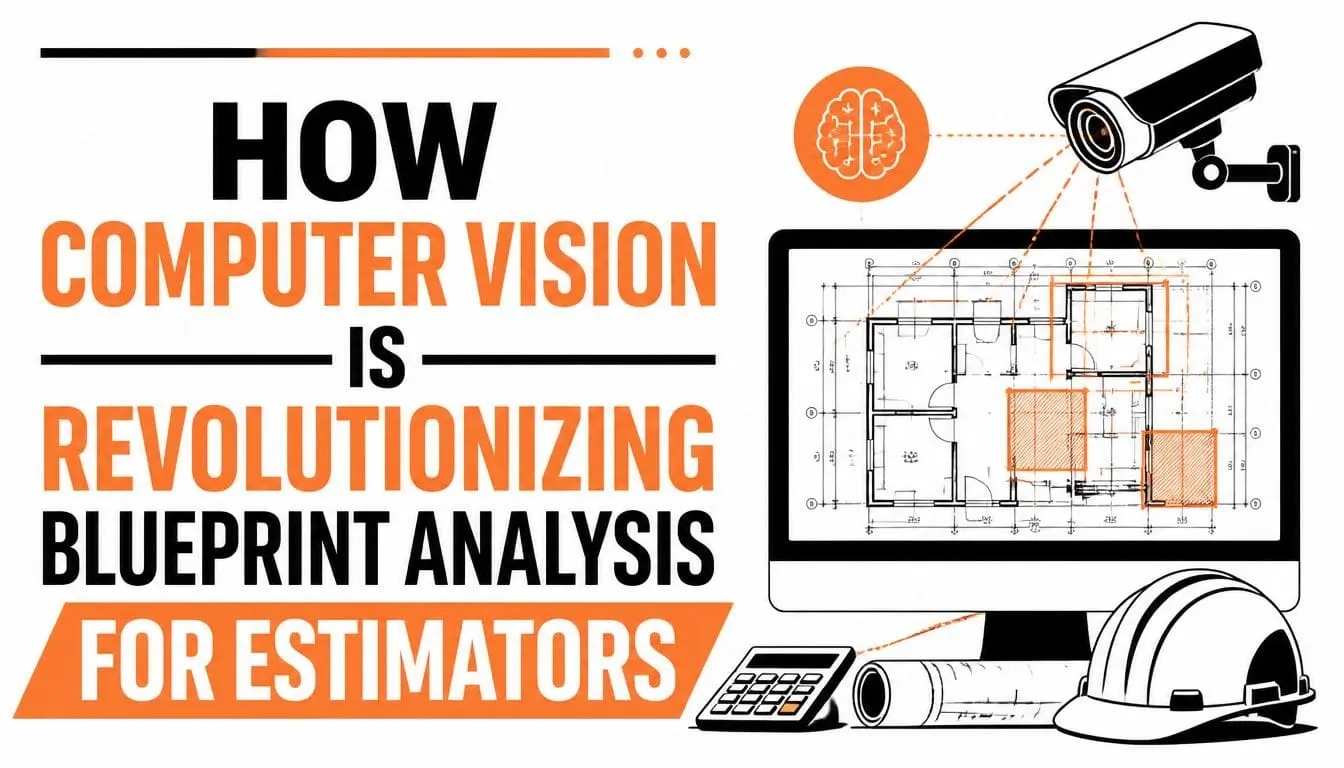
The traditional way for an estimator to work with blueprints was with large, rolled sheets of paper and colored highlighters. Now, the industry is experiencing the greatest change in its history since CAD. This immersive technology facilitates computer-aided Blueprint Analysis for Estimators.
The catalyst in all of this is computer vision, a specialized branch of AI. It enables machines to utilize information from visual inputs directly from digital blueprints and schematics by:
- Interpreting
- Understanding
- Extracting
Thus, teaching computers to see and contextualize drawings exactly like a professional. It means that computer vision is transforming blueprint analysis from a grueling, manual chore into a highly automated, lightning-fast strategic asset.
How Has Computer Vision Revolutionized Blueprint Analysis For Estimators?
Computer vision is not simply observing a PDF as a static image, but rather breaking down the visual chaos of various elements. This breakdown creates structured, actionable data from those elements. A few examples of various elements are as follows:
- Lines
- Hatches
- Curves
- Text
What It Can Do?
Imagine an estimator uploading a 100-page construction plan set to a platform. What do you think will happen? Powered by AI, Computer Vision Blueprint Analysis for Estimators will begin to perform a multi-layered analysis on the submitted drawings, which includes:
- Zone Mapping and Scale Detection
The software will determine the boundaries of each sheet in a plan set. Thus, automatically separates the actual drawings from the title, legend, and notes. In addition, the software will detect dimension strings and scale bars on each sheet at the same time. This will eliminate a common source of manual calibration errors.
- Symbol and Object Recognition
It applies machine learning algorithms to architectural drawings. This will enable the software to immediately identify trade-specific items based on the specific shape and size of the item. For example, the software would recognize:
- A rectangle with an arc attached to it as a door
- A circle with a crosshair near a ceiling line would identify the fixture as a smoke detector
- A set of parallel lines with a distinctly identifiable hatch would designate a specific wall assembly.
- Automatic Calculation of Area and Perimeter
Using computer vision technology will eliminate the need for an estimator to go through each room. This is because it has the feature of spatial clustering of objects and recognition algorithms capable of identifying object boundaries. With these features, the computer can now calculate:
- Total area (for flooring)
- Total volume (for HVAC)
- Total linear feet (for drywall or framing) of all rooms
What Advantages Does Computer Vision Offer in Blueprint Analysis for Estimators
-
Removing bottlenecks: 11x Faster Takeoffs
The primary benefit of using computer vision for blueprints is speed. It takes about 50% – 70% of an estimator’s time to do a takeoff (the process of counting and measuring materials). Reviewing a complex commercial project alone can take weeks.
Because of immersive Construction Takeoff Software, speed has radically changed the competitive position of contractors. In general, more opportunity to submit bids equals greater revenue growth in commercial construction. This is because it drastically reduces the time to complete a takeoff. Thus, estimating departments can ramp up their bid capacity without increasing their overhead.
How to choose the right Platform?
Various platforms can achieve the results you are looking for, but there are some that stand out as the best. One of the top-tier platforms is ConstructConnect Takeoff. With this tool, a takeoff can be done within 10-12 minutes; however, in the past, this used to take a considerable amount of time.
-
Human Fatigue vs. Machine Consistency
Speed may draw attention, but accuracy will secure a contract. Whether novice or seasoned, a human estimator is always subject to fatigue and eye strain. Missing or miscalculating can lead to devastating financial consequences later in the process.
How Does Computer Vision Facilitate?
The use of computer vision models provides an instant backup layer to help validate the information being counted by an estimator. Computer vision models can produce a 95%-98% first-pass accuracy rate. This is done during estimating the quantities that will be found in complex architectural plans.
This precision bridges the gap between traditional 2D drawings and modern BIM Estimating Services. While BIM excels at extracting data natively embedded in 3D models, most project bids are still submitted as flat 2D PDFs. Computer vision acts as an automated translator, instantly turning those 2D static lines into rich, 3D-compatible structural data.
-
Mitigating the Chaos of Revisions
Most construction projects are not built from the very first version of any construction documents. There are design revisions, addenda, and value engineering cycles that have occurred before construction even starts. Before computer vision technology in the past, the only way to compare a set of drawings was through a page-by-page visual review.
How are revisions effectively managed?
Computer vision technology eliminates this difficulty by allowing contractors to visually compare multiple versions of a drawing automatically. This comparison is done with AI-integrated software that will overlay drawing sets automatically.
Does Computer Vision Affect Modern Estimating Services?
Technological automation is widely debated to see if it means replacing human jobs with robots. The response as it pertains to estimating for construction is absolutely NO! Rather, it will increase the level of professionalism and value of the estimator’s job.
Computer vision can efficiently and swiftly handle the repetitive and boring work of clicking and counting items. Thus allowing estimators to have more time to spend on the higher-value strategic aspects of their position.
Emerging organizations as well as premier estimating firms use this method of automatic data extraction to redirect effort to more critical areas. A well-known and credible example is Universe Estimating. As they devote more time to analyze:
- Market risk
- Negotiating supply rates with suppliers
- Developing solid working relationships with trade subcontractors
- Executing proactive, valuable engineering.
Final Words
In the end, computer vision has completely changed the process of Blueprint Analysis for Estimators. With this technology, the traditional method of entering information into a spreadsheet has changed. By automating multiple processes, traditional barriers that have historically limited the work of preconstruction teams are now eliminated. By embracing this technological change, contractors are able to redefine what their operational capacity is. Thus, they create more accurate bids in much less time than was previously possible. In an industry where profit margins are shrinking while project complexity continues to grow, computer vision represents the ultimate competitive advantage. Thus, allowing them to provide their clients with bids backed by accurate data, rather than guesses.
FAQs
Q1: Will human estimators be replaced by computer vision during the preconstruction phase?
A: No, there will never be a complete replacement. Computer vision can automate the monotonous and repetitive task of taking photographs of items and counting them. However, it cannot replace the human/checklist ability of having context for making a judgment based on real-world situations.
Q2: How does computer vision perform with sketchy, hand-drawn or scanned blueprints that have a low resolution?
A: The best computer vision models can differentiate between noise and text using advanced optical character recognition (OCR) and pixel mapping techniques. However, the models will perform poorly due to low confidence when:
- The drawing is not drawn to scale
- Or there are areas of text that are illegible
Q3: Is there a way for computer vision software to learn about custom symbols that differ from those in standard architectural legends?
A: Yes, today’s systems utilize adaptive machine learning loops or machine learning algorithms. When machines find an unusual or proprietary symbol, they will use a “detector” to find it in all areas of the document. For example, if you create a custom electric device that does not include a conventional legend. Once the detector locates the symbol, it will search through the document to find and count all other matches to that specific example.