
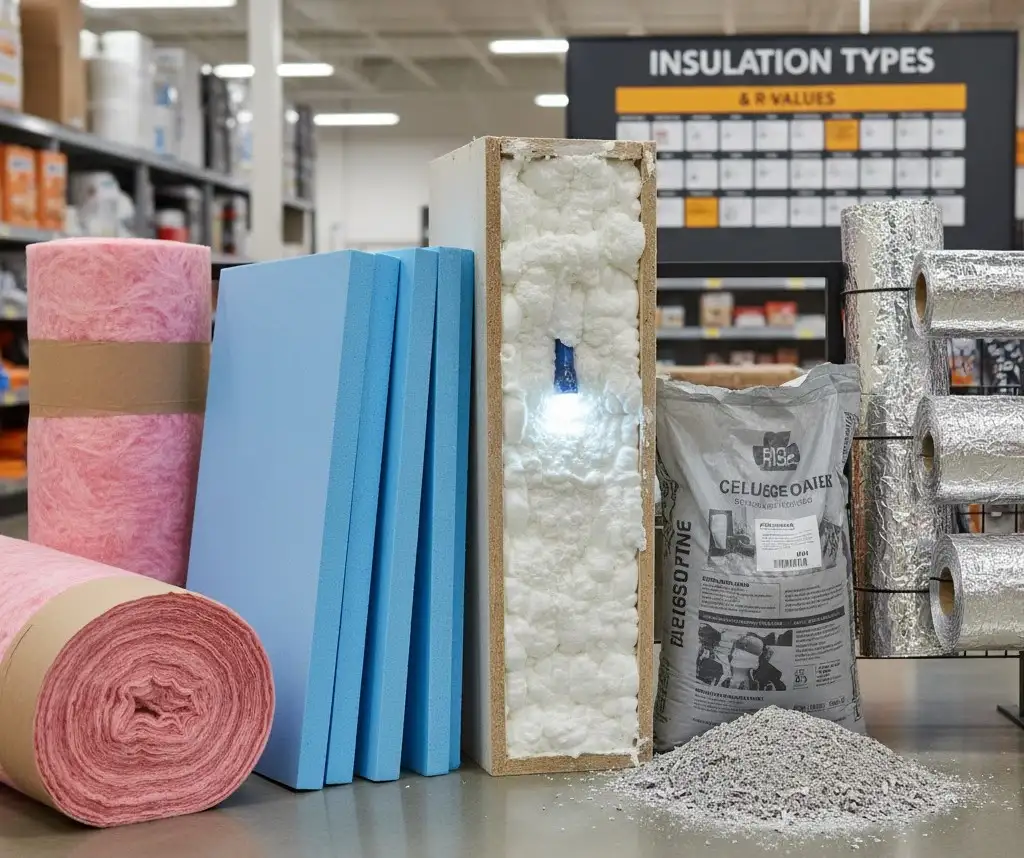
From all types of insulation, you need to choose the right one that provides you comfort and comes within your budget. Insulation is one of the most important components of a building that controls heat flow indoors. This is the most important function that keeps the buildings warm in winter and cold in summer. But the main issue is which HVAC systems are suitable for your building? A variety of types are available in the market. One must know about R-values, which measure thermal resistance.
If you are going to install such systems, you must have proper knowledge about them. If you want to install without any issues, get expert Insulation Estimating Services from reliable companies. They provide an accurate cost breakdown of all elements included in the project. Now, let us provide you with the right information about R-value to proceed with this guide.
DIG INTO A DETAILED GUIDE TO LEARN ABOUT ALL TYPES OF INSULATION AND THEIR BENEFITS, AND SELECT THE RIGHT ONE FOR YOUR BUILDING!
Understanding R-Value
R-value measures the amount of resistance a material contains.
If your R-value is higher, that means the material will keep the inside temperature better. So it is the main thing that shows the maintained indoor temperature and reduces the energy bill.
Well, it is true that R-value measures thermal resistance. But lower bills depend on proper installation and air sealing.
Traditional Insulation Types
Fiberglass Insulation
Fiberglass is the most famous insulation option. It consists of flexible fibers and comes in the form of batts or rolls.
- R-value is R-3.0 – R-4.3 per inch
- Cost is almost $0.40 – $0.70 per square foot
Advantages
- Most affordable insulation option
- Widely available and easy to install
- Non-combustible material
- Works well for attics and walls
It is recommended to use it in attics, floors, and areas where budget is a primary concern.
Cellulose Insulation
This insulation is made from recycled paper. They are inserted into the empty spaces of the wall. It is famous among those builders who are concerned with eco-friendly options.
- R-value ranges from 3.2 – 3.8 per inch
- Cost ranges between $0.50 – $1.00 per square foot
- Contains 85% recycled materials
Advantages
- You will get made from recycled paper products
- Treated to be fire-resistant
- Can achieve a 20-30% reduction in energy bills
- Better air sealing properties than fiberglass when installed at proper density
- Excellent for retrofit applications
Mineral Wool Insulation
Mineral wool insulation is made from stone. It has a feature that resists high temperatures.
- R-value is almost R-4.0 per inch
- Cost is $0.8 – $1.50 per square foot
Advantages
- It can resist fire
- Excellent sound absorption properties due to dense structure
- It is resistant to moisture and does not attract allergens
- Higher R-values than fiberglass
- This type is also durable and maintains performance over time
Spray Foam Insulation
Spray foam insulation is gaining popularity every year. It is considered the best for saving on electric bills. It does that by filling the gaps and cracks in the building. So, do not waste time and, through precise Cost Estimating, get the required insulation. However, there are two types of this insulation:
Closed-Cell Spray Foam
- R-value is from R-6.0 – R-6.5 per inch
- Provides the highest R-values per inch, which helps in reducing heat
- Adds strength to walls
Open-Cell Spray Foam
- Lower R-value but more flexible
- Provides excellent sound-dampening properties
- More breathable than closed-cell
Advantages
- Highest energy savings of any insulation type
- Creates a complete air seal
- Adds structural strength (closed-cell)
- Superior moisture resistance
- In Florida’s climate, spray foam achieves $800-$1,200 in annual energy savings with a payback period of 3-7 years
Latest Innovative Types of Insulation
Vacuum Insulation Panels
This one is one of the latest Building Insulation technologies available. These panels contain a main material with air evacuated. It creates a vacuum, which helps in reducing the heat transfer. This type of insulation has a high R-value.
Aerogel Insulation
Aerogels consist of lightweight materials. They have high thermal resistance. The best thing about this type is that it has a thin layer and it is more durable.
Smart Insulation
Smart insulation is connected with the Internet of Things to modernize energy efficiency. Such modern materials have sensors that can monitor temperature and the insulation performance. According to the reports, smart systems help in saving 20-30% more energy every year.
Conclusion
Choosing the right types of insulation depends on different factors. It can be about thermal performance, cost, and other needs. The latest materials offer high performance. But they are more expensive. With a precise construction estimating process, you can complete the projects under budget. Make sure to properly install the HVAC systems by considering climate conditions and other major factors. It is better to invest your money one-time and save your energy bills in the future. Always focus on quality and create healthier indoor environments.