
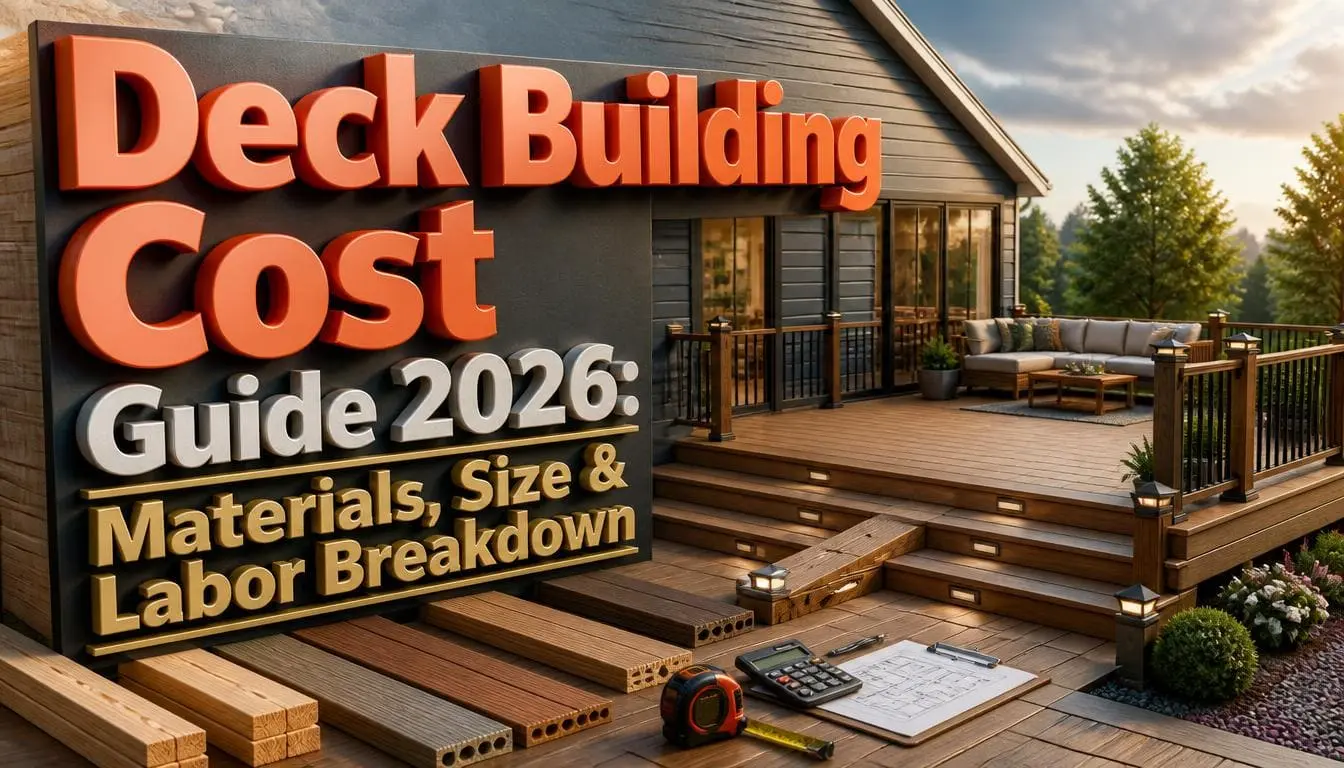
In 2026, most people will pay $25 to $50 for each square foot of deck. A small 12×12 wood deck costs about $3,600 to $7,200. A bigger 20×20 composite deck costs $10,000 to $20,000. Your deck building cost depends on material, size, height, and local labor rates. Material and size decide most of the cost.
Not sure how much lumber your deck needs? Lumber takeoff services count every joist, post, beam, and board before you buy anything.
How Much Does It Cost to Build a Deck in 2026?
The cost to build a deck in 2026 ranges between $3,000 and $25,000 for most homeowners. That is a wide range because a ground-level pine deck and a raised composite deck are not the same job.
HomeGuide’s 2026 pricing data puts a new deck at $25 to $50 per square foot installed. Angi’s 2026 figures run higher, at $30 to $60 per square foot, because their sample includes more second-story and custom builds.
Both are correct. They just describe different decks.
| Deck size | Square feet | Typical installed cost |
| 8×10 | 80 | $2,000 – $4,000 |
| 10×12 | 120 | $3,000 – $6,000 |
| 12×12 | 144 | $3,600 – $7,200 |
| 12×16 | 192 | $4,800 – $9,600 |
| 16×20 | 320 | $8,000 – $16,000 |
| 20×20 | 400 | $10,000 – $20,000 |
Based on $25–$50 per square foot installed. Add 20–40% for second-story decks or premium boards.
What Drives the Deck Cost Per Square Foot 2026 Homeowners Are Quoted?
Six factors move the number. In order of impact:
- Decking material: the single biggest swing. Pine to IPE wood can triple your board budget.
- Height off the ground: anything over 30 inches needs railings, deeper posts, and stairs.
- Local labor rates: a Bay Area crew and a rural Ohio crew price the same deck very differently.
- Shape: curves, angles, and multi-level layouts add cut waste and hours.
- Railing type: cable and glass railing cost more than the deck boards under your feet.
- Site access: a backyard with no gate access means everything gets carried by hand.
Height deserves special attention. A ground-level deck under 30 inches is close to a floor on posts. Raise it eight feet, and you have added footings, bracing, guardrails, and a full stair run. The deck cost per square foot 2026 pricing charts show is almost always based on the ground-level version.
What Do Deck Materials Cost Per Square Foot?
Decking boards alone run $2 to $45 per square foot, according to Angi’s 2026 material data. Most homeowners land between $3 and $20.
| Material | Material only (per sq ft) | Lifespan | Yearly upkeep |
| Pressure-treated pine | $3 – $8 | 10 – 15 years | Stain/seal every 2–3 years |
| Cedar | $4 – $12 | 15 – 20 years | Stain/seal every 2–3 years |
| Redwood | $8 – $20 | 20 – 25 years | Stain/seal every 2–3 years |
| Composite (Trex, TimberTech) | $5 – $20 | 25 – 30 years | Wash only |
| PVC / vinyl | $5 – $13 | 30+ years | Wash only |
| Ipe / tropical hardwood | $10 – $20 | 40 – 50 years | Oil yearly (optional) |
The frame is pressure-treated lumber no matter which deck surface you pick. Joists, beams, and posts are almost always PT pine. So when you upgrade from wood to composite, you are only paying more for the boards and railing, not the whole structure. That is why the price gap is smaller than people expect.
Waste is the other quiet cost. For example, a 16-foot board cut to 14 feet leaves 2 feet of waste. Builders who get an accurate construction takeoff before ordering rarely end up with three unused bundles in the driveway or a second delivery fee mid-job.
How Much of a Deck’s Price Is Labor?
Labor is roughly half the total bill. HomeGuide prices deck labor at $11 to $22 per square foot. Angi’s contractor network reports $15 to $35 per square foot for more complex builds.
Here is where those hours go on a typical 320-square-foot deck:
- Layout and footings: 1 to 2 days. The frost line decides how deep the holes need to be.
- Framing: 1 to 2 days. Ledger board, beams, joists, and blocking.
- Decking boards: 1 to 2 days. Hidden fasteners take longer than face screws.
- Railings and stairs: 1 to 2 days. Stairs take more time than anything else per linear foot.
- Inspections: often two visits, footing and final, with waiting time between them.
Composite installs take longer than wood. The boards need tighter spacing control and hidden clips. Expect 10 to 20% more labor hours for the same size deck.
How Does Deck Size Change the Price?
The total price goes up as the deck gets bigger but not at the same rate. A deck that is twice as big does not always cost twice as much.
Why bigger decks cost less per square foot:
- Mobilization, permits, and design are fixed costs spread over a larger area
- Long joist runs use lumber more efficiently than short ones
- The crew is already on site
Why bigger decks can cost more per square foot:
- Spans over 16 feet need larger beams or an extra post line
- More area may push you into a stricter permit or engineering review
- Bigger decks often need more stairs and railing
The practical takeaway: adding 40 square feet to a planned deck is usually cheap. Adding a second level costs much more.
Composite Decking Cost vs. Wood Deck Cost: Which Is Cheaper Long-Term?
Wood is cheaper at first. Composite becomes cheaper around year 12.
A wood deck needs cleaning, sanding, and re-staining every two to three years. Materials plus a weekend of work, or $500 to $1,200 if you hire it out. Over 20 years, that is seven or eight cycles.
Twenty-year cost for a 320 square foot deck:
| Cost Item | Pressure-treated wood | Mid-grade composite |
| Install | $6,000 – $15,500 | $13,000 – $24,000 |
| Restaining (7 cycles) | $3,500 – $8,400 | $0 |
| Board replacement | Likely once | Unlikely |
| 20-year total | $9,500 – $23,900+ | $13,000 – $24,000 |
Where you land in those ranges decides the answer. At the top end, composite catches up to wood around year 12 to 15, because a $15,500 wood deck plus seven restaining cycles and a board replacement runs past a $24,000 composite deck you only wash. At the bottom end, a basic $6,000 pine deck that you stain yourself stays cheaper for the full twenty years. Composite wins when you hire out the maintenance. Wood wins when you do it yourself and keep the build simple.
If you plan to sell in five years, buy wood. If this is your forever house and you would rather not spend a weekend staining every third spring, buy composite.
Climate can change the cost too. In humid Gulf states and hot Southwest areas, wood wears out faster and needs more care.
Does a Deck Actually Add Value to Your Home?
Yes, and it beats most interior remodels. Zonda’s 2025 Cost vs. Value Report, the 38th annual edition of the industry’s benchmark study, found that 8 of the top 10 highest-ROI remodeling projects are exterior projects. Interior kitchen and bath remodels ranked lower because buyer tastes vary so widely.
The report’s benchmark deck is worth knowing when you compare quotes. JLC’s published project spec for a wood deck addition is a 16×20 deck on pressure-treated joists and 4×4 posts set on concrete piers, with a built-in bench and planter, three steps to grade, and a full wood railing system.
That is a loaded deck. It costs more per square foot than a plain rectangle with no bench. If a contractor’s quote looks high against a national average, check whether the average includes built-in features and a full stair run.
Why Are 2026 Deck Prices Different from Last Year?
Material inflation is the reason. Building material prices excluding energy rose 3.7% in April 2026. This was the fastest pace in three years, according to the National Association of Home Builders’ analysis of Producer Price Index data. Material prices have run above 3% annual inflation every month since July 2025.
One development worth watching is that preliminary duty rates on Canadian softwood lumber have been cut from a combined 35.2% to 25.9%. These are preliminary determinations, not final rates, so they can still move before they are locked in. If they hold, lower duties ease pressure on framing lumber, which is what your joists and posts are made of.
Metal is the pain point. Metal molding and trim prices have run 40% or more above last year, which hits joist hangers, structural screws, and aluminum railing hardest.
What this means for your budget: get quotes with a written price-validity window. Thirty days is standard. Anything longer usually means the contractor has padded the material line.
How Can You Lower Your Deck Building Cost Without Cutting Quality?
Seven moves that save real money and none that create a weak deck:
- Build at ground level: Staying under 30 inches skips guardrails and deeper posts. You can save 15 to 25%.
- Keep the shape rectangular: Curves and 45-degree corners add cut waste and labor with no structural benefit.
- Mix materials: Use composite for the surface you walk on. Use pressure-treated wood for the frame and skirting underneath. Nobody looks at the frame anyway.
- Reuse a sound frame: If the existing joists pass inspection, board-only replacement costs a fraction of a full rebuild.
- Build in late fall or winter: Crews are slower after peak season and price accordingly.
- Choose wood railing over cable or glass: This is the easiest five-figure saving on a large deck.
- Get three itemized quotes: Ask each contractor to break out decking, framing, railing, stairs, footings, and permits as separate lines. Do not accept a quote that only says deck install with one total price. You cannot compare it properly.
This itemized-quote rule matters more than anything else on this list. When all three bids are broken out the same way, you can easily see what is different instead of finding a surprise $4,000 price gap later.
The Bottom Line
Your deck building cost is set before the first hole is dug. Material picks the board budget, height picks the structural budget, and your zip code picks the labor rate. Everything after that is small stuff.
So do three things. Get three quotes with all the items listed out. Call your building department and ask about permit rules. And look at your deck-building cost over twenty years, not just what you pay on day one.
Here’s why that last part matters. A wood deck might cost $6,000 to build, but if you spend $8,000 on stain over the years, it wasn’t really the cheap one. A $13,000 composite deck that you just spray with a hose can end up costing you less.