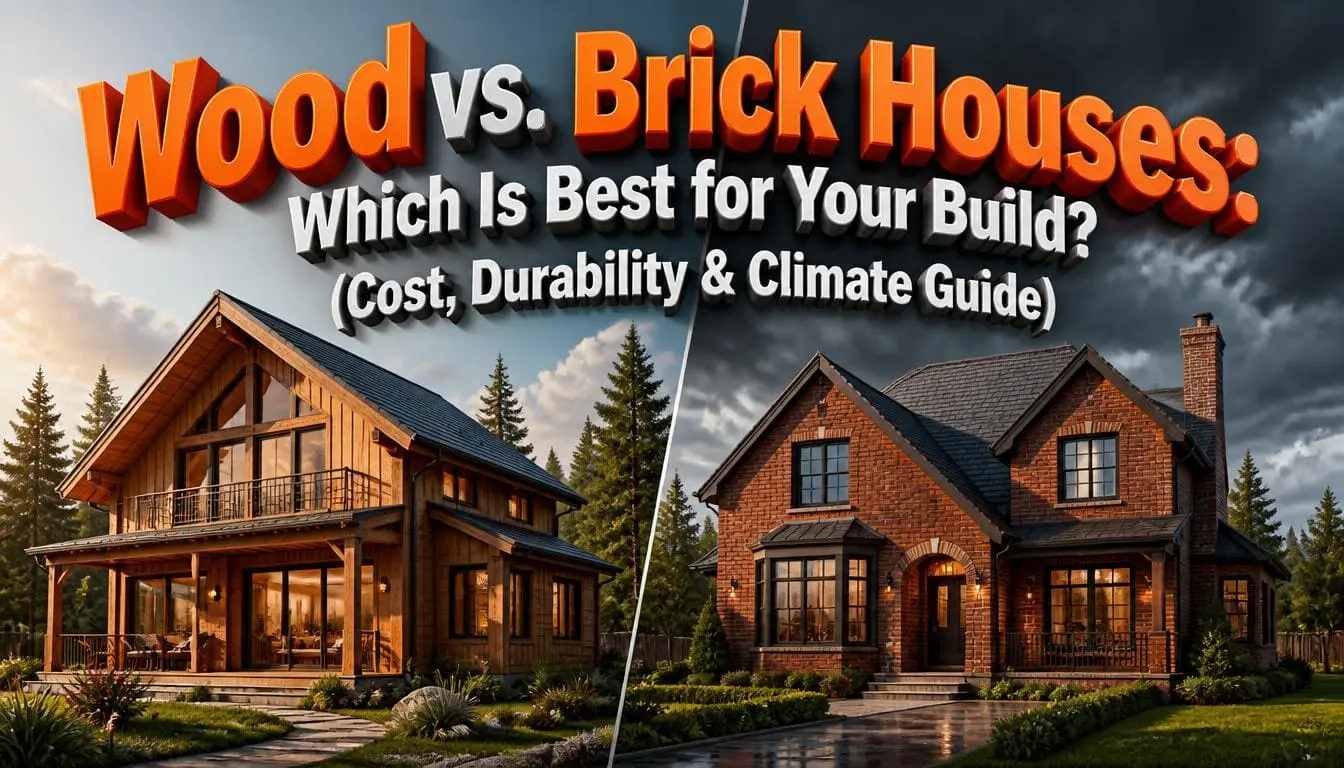
Wood wins on price and build speed. Brick lasts longer, does not burn, and needs less care. For most U.S. builds, the smart answer to the wood vs. brick houses question is a wood frame wrapped in brick veneer on the exposed elevations. You get the masonry look close to wood pricing.
Sort one thing out before you compare bids: builders price walls differently. Most builders quote a lump sum, so the brick upgrade never appears as its own line item. Construction cost estimating services price the wood wall and the brick wall separately at current local rates, turning that gap into a figure you can act on.
Wood vs. Brick Houses: Which One Costs More to Build?
A wood-framed house with standard siding costs roughly 4% to 8% less to build than the same house in brick. On a 2,600 sq ft home, that gap is about $15,000 to $35,000. The brick premium is almost entirely in the wall assembly, not in the rest of the house.
The NAHB Cost of Constructing a Home survey puts the average construction cost for a new single-family home at $428,215, or about $162 per square foot. Framing alone runs about $71,000 of that, with exterior finishes adding another $58,000.
That framing figure swings with how much lumber your plan actually needs. Lumber takeoff services count every stud, plate, and header off the drawings so you know the real board count before anyone orders material. This also catches overruns before cutting starts.
Typical installed cost per square foot of wall:
| Wall cladding | Installed cost/sq ft | Install speed |
| Vinyl siding | $4 – $9 | Fastest |
| Wood siding | $7 – $15 | Fast |
| Fiber cement | $8 – $14 | Moderate |
| Brick veneer | $12 – $22 | Slow |
| Structural brick | $30 – $50+ | Slowest |
The wood house vs brick houses cost gap widens on complicated designs. Every corner, arch, and window opening adds masonry labor.
Timber frame home cost also sits above standard stick framing. Exposed post-and-beam is a premium option, not a budget wood option.
Which Lasts Longer: Brick House or Wood House?
Brick lasts longer with less attention. A well-built brick wall runs 100 years or more before it needs serious work. Wood framing matches that, but only if water stays out of it.
That is the real point on brick vs wood houses durability: water kills houses, not materials.
| What it faces | Brick | Wood |
| Wall lifespan | 100+ years | 100+ years if kept dry |
| Fire | Does not burn | Siding burns |
| Termites and ants | No food value | Needs treatment |
| Hail and debris | Shrugs it off | Dents and splits |
| Earthquakes | Cracks under shaking | Bends and holds |
| Adding a window | Steel beam plus mason | Header plus carpenter |
Brick wins on damage. Wood wins when you remodel.
If you are comparing wood and brick, residential estimating services can break down the material and labor costs for each option. This makes it easier to see which wall system fits your budget and long-term plans.
Is a Modern Brick House Actually Made of Brick?
Usually not. Most “brick homes” built today are wood-framed houses with a single layer of brick hung outside. The brick carries its own weight only. The wood frame carries the house.
Brick veneer vs structural brick is the distinction that changes cost and performance. Veneer is one layer thick, tied to the sheathing with metal ties. It has a one-inch air gap and weep holes to drain water. Structural brick is two or more layers and is load-bearing.
The numbers confirm it. Brick or brick veneer was the principal exterior wall material on just 16.8% of new single-family homes in 2025, down from almost a quarter in 2012, per NAHB’s analysis of 2025 Census data. Brick’s one stronghold is the West South Central division, where it leads at 54%. Wood framing continues to dominate the U.S. single-family home construction market and makes up 94% of completed homes, according to NAHB analysis of 2024 Census Bureau data.
Which Material Handles Your Climate Better?
Choose the wall based on the main weather or safety risks, not just the look.
| Climate or hazard | Better choice | Why |
| Wildfire zones | Brick/masonry | Noncombustible; resists ember ignition |
| Earthquake zones | Wood frame | Wood flexes, masonry cracks |
| Hurricane coasts | Brick veneer | Resists windborne debris |
| Hot and dry | Brick or stucco | Mass delays, afternoon heat gain |
| Cold and wet | Wood frame | Deeper cavities, more insulation |
| Freeze-thaw regions | Wood or SW-grade brick | Standard brick spalls when frozen wet |
Wildfire changes the decision fastest. In 2019, in IBHS’s full-scale wildfire testing, researchers hit a purpose-built duplex with embers. The unprotected side caught fire. The side with noncombustible surfaces and gravel instead of bark mulch did not.
For the national picture, see the NAHB data on U.S. home framing materials, which shows concrete framing at about 9% of Southern completions where storm codes are tightest.
What Does Upkeep Cost Over 30 Years?
Brick costs less to maintain. Wood siding needs to be painted or stained every 5 to 8 years. It costs $3,000 to $8,000 per cycle. That’s 4 to 6 cycles in 30 years.
Brick needs repointing every 25 to 50 years at $8 to $15 per square foot. Most owners do it once, if they need to do it at all.
Brick adds almost nothing to insulation value, though. A four-inch layer of brick is worth about R-0.44. Its benefit is thermal mass, which helps in places where days are hot and nights cool off. The wood cavity behind it carries the real insulation.
So Which Should You Build?
Build with wood if you want a lower upfront cost, faster completion, and easier renovations later. Wood is also a better choice if you’re in a seismic zone.
Build brick veneer over wood framing if you’re in the South or Texas. Brick suits you if you want low maintenance and stronger protection. It also works well if you plan to stay 20-plus years. Build structural brick only for historic restoration.
The Bottom Line
The wood vs. brick houses decision comes down to your climate, how long you’ll own the home, and what your local trades build well. Wood is cheaper, faster, and more flexible. Brick is tougher and cheaper to own. For most builds, wood framing with brick veneer on the visible sides gives you a good balance. Cost and timeline figures throughout reflect current national installed-price ranges and vary by market.