
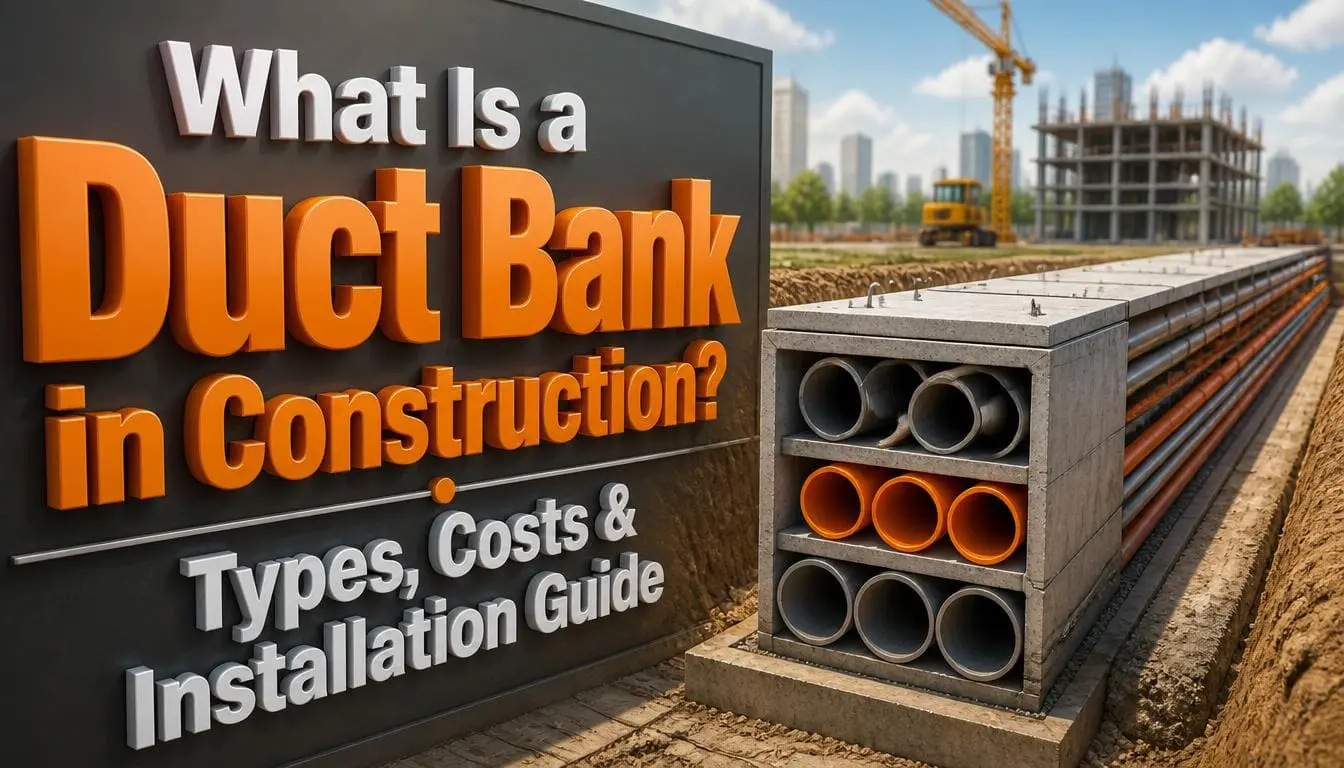
A duct bank in construction is an underground system that holds several electrical, data and communication pipes (conduits) together in one trench. It keeps power, internet, and fiber-optic cables safe from damage, water, and accidental digging. Duct banks are commonly used under roads, parking areas and between buildings. The cost of a duct bank is $35 to $190+ per linear foot, depending on how many conduits it holds. The depth and spacing of the duct bank follow NEC Table rules for safe installation.
Not sure how much conduit, concrete, or labor your duct bank needs? Use professional construction takeoff services to calculate exact quantities for you before you start building.
What Is a Duct Bank in Construction?
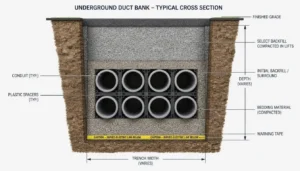
A duct bank in construction is simply a bunch of pipes laid together in one dug-out path (trench). These pipes are kept apart using small plastic holders called spacers. They are covered with concrete or just buried in soil. Each pipe carries its own wire. This allows power, internet and phone cables to run through the same trench while staying safely separated.
The engineers decide how many pipes will be used. This is based on how many wires are needed now and in the future. Most utility companies also ask for a few extra empty pipes, just in case more wires are needed later. So workers don’t have to dig up the road again.
What Are the Different Types of Duct Banks?
There are two main kinds of duct banks: one covered in concrete and one just buried in soil. Which one you use depends on the voltage of the wires, how much traffic is above it, and what the local utility company requires.
Concrete-Encased Duct Bank
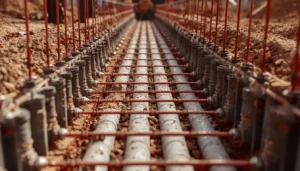
In this type, the pipes are held in place by spacers and then fully covered with concrete. The concrete is usually colored red so that future workers know not to dig there carelessly. This method gives the best protection and is mostly used for high-voltage power lines.
Direct-Buried Duct Bank
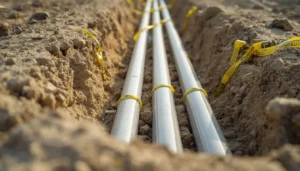
In this type, the pipes are placed directly into sand or soil. No concrete is used. Warning tape is placed above to alert diggers. This method is faster and cheaper, but it can only be used for lower-voltage wires in areas with less traffic.
Hybrid Duct Bank
Some projects use both methods together. They pour concrete only in places like roads (where more protection is needed) and just bury the pipes in soil in gardens or low-traffic areas. This saves money while still protecting the important parts.
Concrete-Encased vs. Direct-Buried Duct Bank: Which One Do You Need?
| Feature | Concrete-Encased Duct Bank | Direct-Buried Duct Bank |
| Best for | High-voltage electrical cables | Low power lights and garden cables |
| Cost | More expensive | Cheaper |
| Installation speed | Slower (concrete needs time to dry) | Faster (no drying time needed) |
| Protection | Very strong; concrete shields the pipes | Depends on depth and tape |
| Heat handling | Better at releasing heat from wires | Wires may need lower power load |
| Traffic/weight handling | Handles roads and heavy weight well | Best for quiet, low-traffic areas |
| Utility rules | Usually required for main power lines | Allowed only for low-voltage lines |
| Long-term strength | Very strong for many years | Okay, depends on soil and depth |
How Much Does a Duct Bank Cost?

A duct bank’s per-foot cost depends heavily on how many conduits it holds. A small 2-way bank runs $35 to $85 per foot while a larger 8-way bank costs between $80 and $190 per foot. Large utility jobs with long runs often come in lower because the crew works faster over distance. Here’s what each part actually costs by size:
Cost Breakdown by Size
| Duct Bank Size | Typical Installed Cost Per Linear Foot |
| 2-way duct bank | $35 – $85 |
| 4-way duct bank | $50 – $120 |
| 6-way duct bank | $65 – $150 |
| 8-way duct bank | $80 – $190 |
Note: Costs rise with conduit count, but not proportionally. The trench, restoration, and traffic control stay roughly the same whether you run two pipes or eight.
Cost Breakdown of Duct Bank by Major Expenses
| Cost Item | Typical Price |
| Digging the trench | $10 – $40 per linear foot (can reach $40 – $75 per foot in rocky or hard ground) |
| PVC pipe, 4-inch (Schedule 40) | $2.20 – $5.50 per foot |
| PVC pipe, 4-inch (Schedule 80, thicker type) | $4.40 – $12.10 per foot |
| Fiberglass pipe | $8.80 – $27.50 per foot |
| Labor to install pipes and spacers | $6 – $15 per linear foot for a 4-way bank |
| Wires/cables | $1.50 – $5 per foot |
| Concrete (for covered duct banks) | $140 – $185 per cubic yard. A 4-pipe bank uses about 0.07 – 0.15 cubic yards per foot |
| Metal rods (rebar) | $3 – $8 per linear foot of duct bank, installed |
| Spacers | Small added cost, placed every 5 feet |
| Backfill and compaction | $5 – $25 per cubic yard |
| Surface restoration (asphalt or concrete) | $4 – $12 per linear foot |
| Vaults or handholes | $950 – $1,900 each, usually placed every 300 – 500 feet |
| Warning tape | $0.12 – $0.55 per linear foot |
| Permits and inspections | $50 – $2,000, depending on the city and roadwork |
| Utility connection fee | $500 – $3,000 |
| Drilling underground (instead of trench) | $10 – $60 per foot |
| Traffic control (for road work) | $500 – $2,500 per day for a standard crew |
If cost estimates are wrong, a contractor can either lose money on the bid (priced too low) or lose the project to a competitor (priced too high). This is why contractors use electrical estimating services to get accurate labor and material pricing before bidding.
What Are the Main Factors That Affect Duct Bank Cost?
| Factor | How It Affects Cost |
| Number of pipes | More pipes mean a wider trench and more concrete |
| Type of covering | Concrete adds cost for material and labor |
| Depth of trench | Deeper trenches need more digging |
| Site conditions | Rocky ground, high water, or permits can raise costs |
How Do You Install a Duct Bank? (Step-by-Step Guide)
Duct bank installation follows clear steps. If you skip any step, it can damage cables or break local rules.
Step 1: Call Before You Dig
Before digging, call your local utility services. They come and mark the spot. This shows where gas, water and power lines run under the ground. It takes just a phone call, but skipping it can cause a lot of trouble.
Step 2: Dig the Trench
Workers dig the trench to the required depth and width according to safety rules. Most trenches are about 20-30 inches deep. The choice depends on the project.
Step 3: Flatten and Firm Up the Bottom
The bottom of the trench should be flat and strong before the pipes are placed. If it’s not solid, the pipes can sink or move later, which can damage the wires inside. This step is quick but very important. Many mistakes happen here.
Step 4: Place the Pipes and Spacers
Now put the pipes in the trench. Use plastic spacers to hold them in place. The spacers keep an equal gap between each pipe.
This gap does two jobs. It protects the cables, and it stops them from getting too hot.
Step 5: Add Metal Rods (If Needed)
If the duct is under a road or heavy traffic area, add the metal rods (rebar). They make the concrete stronger and prevent cracks.
Step 6: Pour Concrete or Fill with Soil
For concrete duct banks, concrete is carefully poured around the pipes without moving them. Red-colored concrete is often used so future workers can recognize it. For direct-buried duct banks, sand or soil is used along with warning tape placed above.
Step 7: Compact and Fix the Surface
Once the concrete dries (or the soil is packed down properly), the surface on top is restored like fixing the road or garden that was dug up. Since concrete takes time to dry, this step can’t be rushed.
What Rules and Standards Apply to Duct Banks?
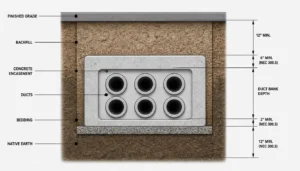
In the US, the main rulebook is NFPA 70 (National Electrical Code). For large utility jobs, IEEE standards give extra guidance. A part of this code is called NEC Table 300.5. It tells you how deep a duct bank must be buried based on voltage and covering type. Concrete-covered duct banks are buried less deeply than direct-buried ones.
Local utility companies often add rules of their own. They add what color to dye the concrete and what warning tape you must use. They may also ask for extra empty pipes for future use.
So always check the local rules first. They are often stricter than the national code.
Conclusion
A duct bank in construction is a practical way to protect underground power, data and communication cables. Choose the right type and install it correctly. This helps avoid damage and reduces future repair costs. If you’re planning a small residential project or a large commercial run, understanding the types, process, and true cost breakdown of a duct bank is very important. It helps you budget accurately and build it right the first time.