
Most homeowners do not think about the coils until the system starts blowing warm air or the energy bill suddenly goes up. That is when knowing the evaporator coil vs condenser coil difference becomes useful. When you understand the difference in the function, cost and maintenance of each coil, it is easier to discuss it with a technician and find issues early. You can also make better replacement decisions and know when a simple coil replacement is enough instead of a full system.
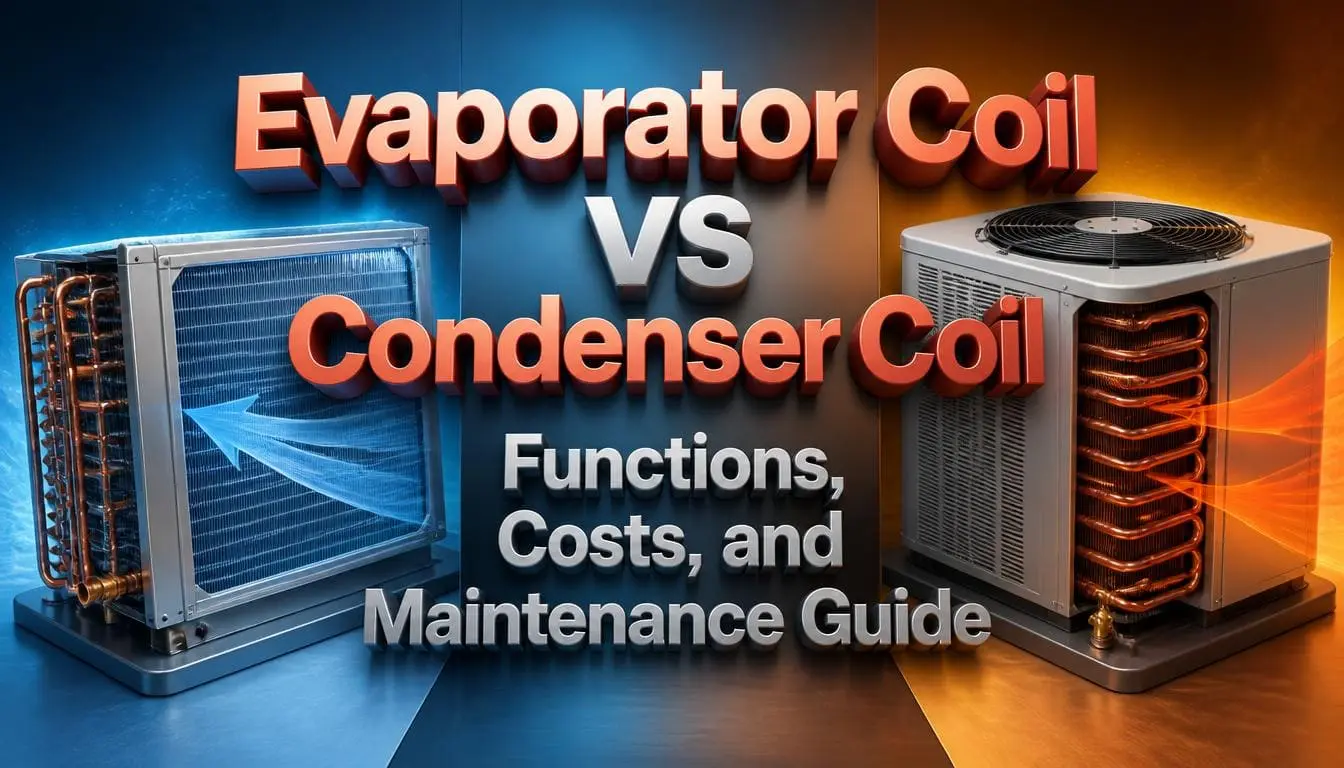
The main difference between these coils is their location and how they work. The evaporator coil is inside your home. It absorbs heat from indoor air. The condenser coil is placed on the outside. It releases the absorbed heat to the outside air. Each coil performs different functions and both work in the same refrigerant loop.
Not sure which coil is causing your AC problem? Check the warning signs below to find out what may be wrong.
Evaporator Coil vs Condenser Coil: What’s the Difference?
| Feature | Evaporator Coil | Condenser Coil |
| Location | Indoors, in the air handler | Outdoors, in the condensing unit |
| Function | Absorbs heat from indoor air | Releases heat into outdoor air |
| Refrigerant state | Liquid enters, gas leaves | Gas enters, liquid leaves |
| Common problems | Freezing, mold, clogged drain | Dirt buildup, bent fins and corrosion |
| Lifespan | 10–15 years | 12–15 years |
| Average repair cost | $600–$2,000 | $800–$3,000 |
What Does an Evaporator Coil Do?
The evaporator coil takes heat from the air inside your home. This helps cool down your home. It is located inside the air handler, above the furnace. It is filled with cold liquid refrigerant.
Refrigerant in the coil absorbs the heat when warm air from your home is blown over the fins of the coil and converts it to gas. This is the actual “cooling” part of the air conditioning system. All other functions in the system exist to support this one part.
Here are a few facts about evaporator coils:
- They are composed of copper or aluminum tubing with thin metal fins that are used to increase surface area.
- They also purify the air from humidity. That is why there is one condensate drain line alongside it.
- When the airflow is restricted due to dirt or the filter vents are closed, the coil has the potential of freezing. It cools off to a temperature below what the surrounding air can maintain.
What Does a Condenser Coil Do?
The job of the condenser coil is opposite to the evaporator coil. It releases heat rather than absorbing it. It is located in the outdoor unit near the compressor and fan.
The refrigerant leaves the evaporator coil as hot gas. It is then further compressed by the compressor. The condenser coil sends the heat outside. The refrigerant turns back into a liquid. Then the cycle starts again.
As the condenser coil is outside, it faces a variety of issues:
- Fins can get clogged by dirt, grass, pollen, and leaves.
- Bad clearance and direct sunlight restrict movement of air and heat.
- Physical damage such as bent fins, hail and weed trimmers.
What Is the Cost to Replace an Evaporator Coil and a Condenser Coil?
The cost to replace an evaporator coil ranges between $600 and $2,000. The cost of most condenser coil replacements is between $800 and $3,000. Coil replacement costs can be hard to estimate. This number will go up and down with the use of labor, coil size and type of refrigerant change the final price.
If these costs are not calculated correctly, you may face unexpected expenses. So many homeowners take help from HVAC estimating services to get a clearer idea of the total repair or replacement cost. These services also look at the current condition of the system. This helps you decide if replacing one coil is enough or if replacing the whole system is a better choice. This way, you can avoid paying for a full system replacement.
There are several factors driving costs up:
- Refrigerant type: Any existing system that is filled with older refrigerant is going to be costlier to maintain or service as R-22 is being phased out and is getting harder to come by.
- Warranty status: If your unit is still under manufacturer warranty, you could only be paying for labour (usually $400 to $1,000) instead of the parts and labour.
- Coil size: Replacing a 1.5 ton coil is cheaper than replacing a 5 ton coil, in terms of parts and labor to install and braze the coil.
It would be better to replace the entire system if one coil fails and the unit is over 10 years old. A failing coil on an old unit is usually a sign the rest of the system will also fail soon.
How to Maintain Evaporator and Condenser Coils?
Simple maintenance steps that actually matter:
- Change the air filter every 1–3 months. A clogged filter is the number one cause of a frozen evaporator coil.
- Clear away 2 ft of space around the outdoor unit. Airflow to the condenser coil is obstructed by bushes, fences, and stored items.
- Flush condenser coil with a garden hose in spring. Don’t use a pressure washer; it will bend the fins.
- Get a professional to check the house every year. The evaporator coil is out of your reach, so you cannot check or clean it. With a tech’s assistance, the refrigerant can be checked and the evaporator coil can be accessed and cleaned professionally.
- Don’t forget to keep the drain line of the condensate unclogged. If the drain line is clogged, water will pool in the evaporator coil area and encourage mold.
- Use a fin comb to comb straight bent fins if necessary.
A dirty coil forces the whole system to work harder and that shows up on your electric bill fast. The U.S. Department of Energy notes that a dirty condenser coil can raise a system’s energy use by up to 30%, since it blocks the heat transfer the whole system depends on. That’s not a small efficiency loss; it’s the difference between a system running normally and one straining through every cycle.
Warning Signs a Coil Needs Attention
Look out for these indicators that a coil requires maintenance:
- Ice on the indoor unit or refrigerant lines is usually a frozen evaporator coil from restricted airflow.
- Warm air from the vents is caused by a problem with either coil but often starts with a dirty or damaged condenser coil.
- Rising energy bills with no usage change are a classic sign of a dirty coil forcing the AC to run longer times.
- Hissing or bubbling sounds are a sign of a refrigerant leak near either coil.
- Water pooling near the indoor unit is because of a clogged drain line or a coil that’s thawing after freezing.
Conclusion
The evaporator coil vs condenser coil comparison comes down to one simple point: both coils need to work properly for your AC to cool your home. Coil failures do not happen suddenly. They fail gradually due to dirt, lack of airflow, and lack of maintenance (tune-ups).
A homeowner who keeps coils clean, hoses down the outdoor coil every spring and changes the filter on a monthly basis rarely ends up facing a surprise coil replacement. If one coil breaks, inspect the system to check if the coils are old or in good condition and then consider paying for a full replacement. Sometimes, replacing one bad coil is all your AC needs to keep working for years to come.