
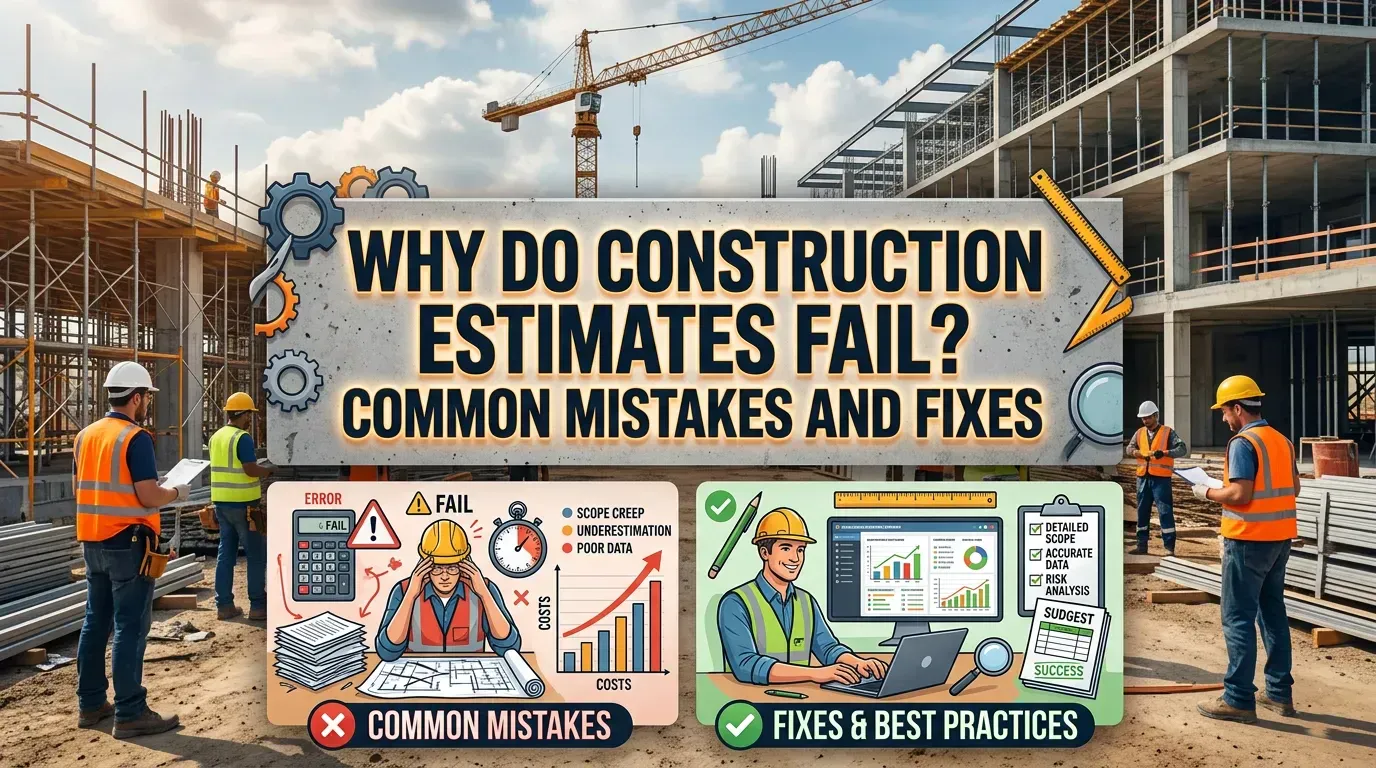
Construction estimating mistakes lead to huge failures. The rising cost of materials and labour shortage have made the profit margins quite thinner. Today, the market is not relying on a past project’s guidelines. It depends on the market resets! It is a state where the pricing no longer follows predictable cycles and labour availability fluctuates month-to-month.
According to the current data, 95% of the projects experience some level of delay. Some may also experience a little overrun. Most of the contractors do not lose money because they cannot estimate. They lose money because their estimates rely on assumptions. For this reason, many are outsourcing construction estimating services to reliable companies. This helps them prevent construction estimation errors and complete the products under budget.
LET’S SEE WHY CONSTRUCTION ESTIMATES FAIL AND THE COMMON MISTAKES AND FIXES!
The “Ghost” Labour Costs
One of the most common questions among individuals is why construction estimates fail! Many reasons are discussed in this article for you.
If we go into the past, the labour was estimated by multiplying the hourly wage by the estimated man-hours. But now, it is not recommended at all. The common mistakes are:
1. Relying on Base Rates
Still, many estimators overlook the labour burden. It has the true cost of an employee beyond their basic check. This includes:
- payroll taxes
- workers’ comp
- Benefits
- non-productive hours
2. Productivity-Led Forecasting
To fix it, calculate the total cost of labour, including every overhead cent. Plus, use field data to track how specific crews perform on specific tasks.
You must know that labour typically accounts for 60% of a project budget. Even a little dip in productivity can wipe out your entire profit margin.
The “Paper-Only” Site Assessment
Mistake: Skipping the Site Visit
One of the common estimating mistakes in construction is relying on just the site conditions. Unexpected soil situations or poor road access for heavy equipment can lead to massive change orders.
Fix: Mandatory Physical or “Digital Twin” Surveys
To handle this mistake, you can implement different techniques. The most common ones are as follows:
- If your physical visit is impossible, then use high-resolution 3D drone scans. This will help to update your Building Information Modelling (BIM) site model.
- Bring key subcontractors to the site. Their specialised eyes will spot “hidden” costs!
Flawed Material Takeoffs and Procurement Lags
Mistake: Static Pricing in a Dynamic Market
Most of the estimators use pricing from the start of the bid phase. But the proposal is often awarded 3 to 6 months later. In these months, the market changes a lot. The manual quantity takeoffs are one of the main causes of inaccurate construction estimates.
The Fix: Index-Aware Estimating and AI Takeoffs
AI Takeoffs
Use software like Stack or Autodesk Construction Cloud to automate the counting of items. This reduces the error rate from 15% to less than 5%.
Procurement Hedging
Use Index-Aware Estimating, which pegs material costs to current market indices rather than static quotes.
Inadequate Contingency
The Mistake: The “Catch-All” Contingency
Contingency is an extra amount that covers unexpected situations during the project. This helps to cover avoidable mistakes like poor planning.
The Fix: Governed, Risk-Based Contingency
| Risk Type | Estimation Strategy |
| Known Unknowns (e.g., Weather) | Use historical weather patterns to set a specific “Weather Contingency” fund. |
| Market Volatility | Use a “Price Movement” allowance tied to specific high-risk materials (Steel/Copper). |
| Design Gaps | Assign a “Design Evolution” percentage based on the completeness of the drawings (e.g., 15% for conceptual, 2% for IFC). |
Information Silos and Communication Gaps
The most common reason for the estimate error is that the people building the project are not talking to the people who priced it. If you rely on professional construction cost estimating services, you will never have to face such mistakes!
The Mistake: The Handover Gap
When an estimate is just handed over to a project manager, it is like a normal document. The assumptions of the estimator are lost. If the estimator has predicted a 4-man requirement, but the PM schedules six. The labour budget will go up on day one.
The Fix: Integrated Digital Ecosystems
- Use cloud-based platforms like Procore
- Conduct “Post-Mortem” meetings.
Summary Checklist for a Defensible Estimate
If you want to survive in this competitive market, then you need to avoid construction cost estimation mistakes at all costs. You need to make sure that your estimating process covers every little thing from start to end.
- Use fully burdened rates and crew-specific productivity data.
- Never bid “blind”; use drones or boots on the ground.
- Eliminate manual spreadsheet errors with AI-counting tools.
- Use index-linked pricing and escalation clauses for volatile materials.
- Don’t just add 10%; calculate risk based on design maturity.
- Feed field data back into the estimating software for real-time accuracy.
Conclusion
The construction estimating mistakes arise due to a lack of agility. In this competitive industry, time is money. It is replaced by certainty as profit. You need to know that the most successful companies are those that treat the estimates as a living document. They keep updating the components and other details live, according to the current market conditions. This way prevents mistakes and handles the risks effectively.