
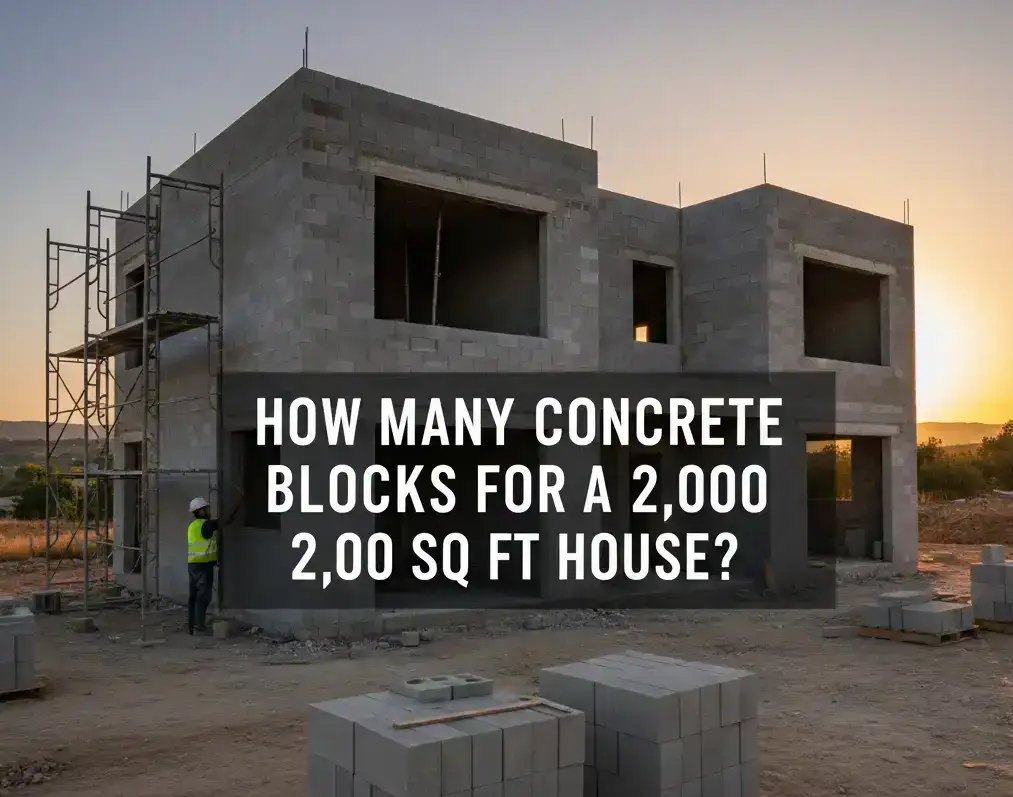
An online concrete block calculator for a house provides a rough estimate according to your area. Building a home with concrete masonry units is becoming quite popular. It provides durability and long-term value.
Suppose you’re planning to construct a 2,000-square-foot house. You will be asking yourself one question: how many blocks will you need? This comprehensive guide is prepared for you to explore the calculation methods and the factors that affect the number of concrete blocks for a house of this size.
Understanding Standard Concrete Block Dimensions
Before calculating, it is important to know the standard concrete block size used in most construction projects.
The most common concrete masonry unit measures:
- 8 inches high
- 8 inches deep
- 16 inches long
These dimensions are very important to determine how many blocks you’ll need. For your information, one standard block covers one 128 in.² of wall surfaces.
CMU blocks for residential construction come in various sizes. It includes
- 4-inch
- 6-inch
- 10-inch
- 12-inch
The widht depend on the structural and insulation requirements.
Key Factors Affecting Block Quantity
Several important factors influence the total blocks required for a 2000 sq ft house construction:
Wall Height and Perimeter
- The standard wall height for a single-story home is typically 8 to 10 feet
- A two-story home requires double the wall height for exterior walls
- The perimeter of your 2,000 sq ft house determines the linear footage of walls
Wall Thickness
- Standard 8-inch blocks are most common for residential construction
- Load-bearing walls may require thicker blocks
- Non-load-bearing interior partitions might use thinner blocks
Window and Door Openings
- Each opening reduces the number of blocks needed
- Average homes have 10-15 windows and 3-5 doors
- Openings typically account for a 10-15% reduction in total blocks
Wall Configuration
- Interior partition walls add to the total count
- Single-wythe vs. double-wythe construction affects quantities
- Architectural features like columns increase requirements
The Basic Calculation Formula
To know about the concrete block estimation formula for your project. You need to follow these steps:
Step 1: Calculate Wall Area
- Perimeter = 2(40 + 50) = 180 linear feet
- Wall height = 10 feet (including foundation)
- Total wall area = 180 × 10 = 1,800 square feet
Step 2: Consider Openings
- Subtract approximately 15% for windows and doors
- Adjusted wall area = 1,800 × 0.85 = 1,530 square feet
Step 3: Calculate Blocks Per Square Foot
The industry standard is almost 112.5 concrete blocks per square foot. It is for standard 8×8×16 blocks with ⅜-inch mortar joints.
Step 4: Final Block Count
- Total blocks needed = 1,530 × 112.5 = 1,721 blocks
- Add 5-10% for waste and cuts = 1,721 × 1.08 = approximately 1,860 blocks
Using a Concrete Block Calculator for Accuracy
It is now understood that manual calculations provide estimates, but a concrete block calculator for a house offers more precise results. If you rely on a reliable estimator. They use advanced calculators that consider:
- Exact house dimensions and floor plans
- Specific block sizes and configurations
- Detailed window and door schedules
- Corner blocks and special shapes
- Local building code requirements
- Waste factors based on project complexity
There are several estimating companies that now offer concrete block wall calculation services. They provide quick and accurate estimates for your project.
Professional Masonry Block Quantity Takeoff
For complex projects, professional masonry block quantity takeoff services provide the most accurate estimates. These services deliver a detailed material list that includes:
- Primary wall blocks by size and type
- Corner blocks and cap blocks
- Bond beam blocks for reinforcement
- Mortar quantities
- Rebar and reinforcement materials
- Grout requirements
- Waterproofing materials
These expert concrete block takeoff services charge almost $500 – $2,000 for residential projects. But this will save you thousands by preventing material shortages.
Interior Walls and Additional Considerations
Do not ignore residential concrete block walls for interior partitions in your calculations. It includes:
- Kitchen-bathroom wall separations
- Bedroom partition walls
- Utility room enclosures
- Garage walls (if attached)
Current Cost Considerations
Understanding the concrete block cost estimation is important for budget planning.
Material Costs
- Standard 8×8×16 CMU blocks: $1.50 to $3.00 per block
Additional Materials
- Mortar: $8-15 per bag
- Rebar reinforcement: $1-2 per linear foot
- Grout for core filling: $0.50-1.00 per block
- Waterproofing and sealing: $2-4 per square foot
Labor Costs
Professionals charge $5-13 per square foot for installation. This includes:
- Block laying
- Mortar application
- Reinforcement placement
- Quality control
- Cleanup
Professional builders create detailed material estimates. A complete concrete block house material estimate for a 2,000 sq ft home includes:
Foundation Level:
- Below-grade blocks: 600-800 units
- Waterproofing membranes
- Drainage systems
- Footing materials
Wall Construction:
- Standard face blocks: 1,500-1,800 units
- Corner blocks: 80-120 units
- Bond beam blocks: 150-200 units
- Lintel blocks: 40-60 units
Finishing Materials:
- Cap blocks or coping: 180-200 linear feet
- Control joints
- Flashing materials
- Mortar coloring (if desired)
Conclusion
Calculating the blocks needed for a required square foot house requires careful consideration of multiple factors. From basic wall dimensions to complex architectural details. You have to be very careful. To sum it up, such a home requires almost 2,200-2,600 concrete blocks. This is based on design, height, and other details.